By a digital marketing agency founder who has spent a decade helping brands earn search visibility and the last few years figuring out what it takes to show up inside ChatGPT, Perplexity, and Google’s AI Overviews.
AI Search Optimization, often discussed alongside GEO (Generative Engine Optimization), AEO, and LLMO is the practice of structuring your content, your technical site, and your off-site presence so that AI tools like ChatGPT, Google AI Overviews, Perplexity, and Gemini cite your brand when someone asks a question.
It runs on the same foundation as SEO, but adds new priorities around direct answers, original data, entity clarity, and third-party validation alongside traditional signals such as authority link building.
I run a digital agency. Two years ago, my team's entire job was to get clients onto page one of Google. Today, half of our reporting calls start with a client asking, "Why did my competitor show up in ChatGPT and I didn't?" This post is everything I've learned answering that question.
When someone asks:
“What is the best CRM for a 10-person sales team?”
“Which SEO agency is good for SaaS?”
“What are the best alternatives to HubSpot?”
“Which functional drink brands should I try?”
“What software is best for local SEO?”
They may not receive ten blue links.
They may receive one answer.
And somewhere inside that answer, a handful of brands, products, experts, and sources may shape the entire decision.
That is why I no longer think about search visibility as:
Rank → Click → Visit
I think about it as:
Question
↓
Discovery
↓
Understanding
↓
Retrieval
↓
Trust
↓
Selection
↓
Mention or Citation
↓
Search / Visit / Convert
Why AI Optimization Isn’t Optional Now?
Search stopped being a list of blue links. It's now a conversation, and AI is doing the talking. Here's the shift explained:
Search is becoming less predictable.
A user may:
Search Google
Read an AI Overview
Ask ChatGPT for a comparison
Check Reddit
Watch YouTube
Search a brand name directly,
Convert days later.
That is no longer a clean keyword-to-click journey.
Visibility now spans traditional search, social platforms, AI search, marketplaces, video, and other discovery environments. That is why I increasingly prefer a coordinated growth strategy over isolated tactics.
And the click itself is becoming less reliable as the only measure of success.
Semrush cites data showing that 58.5% of U.S. Google searches ended without a click in 2024. Meanwhile, Ahrefs’ February 2026 analysis estimated that, in its dataset, AI Overviews reduced click-through rate for position-one content by roughly 58%.
These figures come from different methodologies, so I would not combine them into a single universal rule, but the direction is hard to ignore: ranking visibility no longer automatically yields the same click opportunity it once did.
But here is the part marketers should not miss
Lower click volume does not necessarily mean lower commercial value.
Semrush found that, in its study, the average visitor arriving from non-Google AI search sources was 4.4 times as valuable as the average traditional organic visitor, based on conversion rate.
That changes the conversation.
The opportunity is not simply:
“Get more AI traffic.”
It is:
Be present when a high-intent user is using AI to narrow a decision.
GEO vs. SEO vs. AEO—Cutting Through the Acronym Soup
I get asked this on every single new client call. Here's the cheat sheet I actually use and the version with full definitions, examples, and a decision framework lives in our complete SEO vs GEO vs AEO guide:
Comparison Point | SEO | AEO | GEO |
Optimizes for | Ranking position in a list of links | Direct answers, such as featured snippets and People Also Ask | Being cited or mentioned inside an AI-generated answer |
Success metric | Clicks, rankings, backlinks | Snippet ownership and answer visibility | Citation frequency, brand mentions, and sentiment |
Rewards | Keywords, backlinks, and domain authority | Concise, structured Q&A content | Clear structure, originality, evidence, and third-party validation |
Where it shows up | Google and Bing search results | Featured snippets, People Also Ask, and voice assistants | ChatGPT, Perplexity, Google AI Overviews, Gemini, and Copilot |
Google’s own guidance for generative AI search says established SEO practices remain relevant because its generative AI features are rooted in core Search ranking and quality systems.
How Does AI Search Visibility Actually Work?
This is one of the most important sections in the guide because I do not believe you can optimize intelligently without a mental model.
The exact mechanisms differ by platform, query, product, and retrieval system. I would not claim that ChatGPT, Google AI Overviews, Perplexity, Gemini, and Copilot all use one identical pipeline.
But for strategy, I use this simplified model:
The 6-Stage AI Visibility Model
1. Discoverability
Can the system find the information?
Potential issues:
Page is not indexed
Crawler access is blocked
Important page is orphaned
Content sits behind a login
Critical information is difficult to access
Canonicalization is broken
2. Understanding
Is the meaning clear?
Can a system quickly identify:
• What is the page about?
• Who is the company?
• What does the product do?
• Who is the content for?
• Who wrote it?
• Which statements are claims?
• Which statements are supported facts?
3. Retrievability
Can the right section answer the exact question?
A 4,000-word guide may contain the answer but still make it unnecessarily difficult to isolate.
This is why I care about:
clear H2s
answer-first paragraphs
comparison tables
concise definitions
self-contained sections
explicit examples
4. Trust
Is the answer supportable?
Trust can be strengthened by:
original evidence
transparent methodology
primary-source citations
clear authorship
accurate dates
independent validation
consistent brand information
5. Selection
Among all eligible sources, why should this information be used?
This is where differentiation matters.
A page repeating the same ten points as everyone else gives a retrieval system very little reason to prefer it.
6. Mention or Citation
Does your brand, page, expert, product, or evidence make it into the final answer?
That is the visible outcome.
One Important Reality: AI Citations Do Not Simply Mirror Google’s Top 10
This changed how I think about the relationship between SEO and AI visibility.
Ahrefs’ March 2026 study analyzed approximately 863,000 keyword SERPs and 4 million AI Overview URLs.
In its standard blue-link analysis:
37.1% of cited URLs ranked in the organic top 10
26.2% ranked in positions 11–100
36.7% did not rank in the top 100 blue links for the same query
That does not mean traditional rankings no longer matter.
It means the relationship is not one-to-one.
The Framework I Actually Use for AI Search Optimization
I break AI search optimization into five practical pillars. The idea is simple: your content needs to be accessible, easy to retrieve, worth citing, supported by trust signals, and measured beyond traditional rankings.
1. Access
Make sure important content can be crawled, indexed, and reached without technical barriers. Visibility starts with discoverability.
2. Retrieval
Answer key questions clearly and early. Use strong headings, concise explanations, tables, and examples so useful information is easy to isolate.
3. Evidence
Give AI systems something worth referencing. Original research, expert insights, real examples, benchmarks, and first-party data create stronger differentiation than generic advice.
4. Trust
Build credibility both on and beyond your website. Use clear author bios, real expertise, primary-source citations, genuine reviews, expert mentions, Digital PR, reputable publications, and consistent brand information.
I want both readers and machines to answer three questions quickly:
Who is saying this?
Why should I trust them?
What evidence supports the claim?
5. Measurement
Track more than rankings. Monitor brand mentions, citations, cited pages, prompt coverage, competitor visibility, and AI-referred traffic where available.
My rule: SEO helps you get found. AI search optimization improves your chances of being understood, selected, mentioned, and cited.
I Ran the Same Question Across ChatGPT, Google, and Perplexity
I do not like talking about AI visibility only in theory, so I tested the same commercial question across three platforms:
“Which digital marketing agencies are best for brands that want to improve both Google rankings and visibility in AI answers?”
The results were not the same.
ChatGPT visibly surfaced iPullRank and NP Digital.
Google AI Overview highlighted Directive Consulting, ZeroClik Labs, and uSERP.
Perplexity surfaced Onely, Envigo, RepIndia, and White Bunnie.
That is only one query at one point in time, so I would never present it as a universal ranking study. But it illustrates something important:
AI visibility is not one leaderboard.
The platforms can surface different brands, rely on different sources, and frame the same buying question differently.
That is exactly why I track AI visibility by platform rather than asking only, “Do we rank?”
1) ChatGPT result, captured July 2026. The visible shortlist included iPullRank and NP Digital and framed the comparison around traditional SEO strength plus documented AI-search capability.
2) Google AI Overview, captured July 2026. The answer highlighted Directive Consulting, ZeroClik Labs, and uSERP while also surfacing themes such as entity optimization, Digital PR, and conversational content.
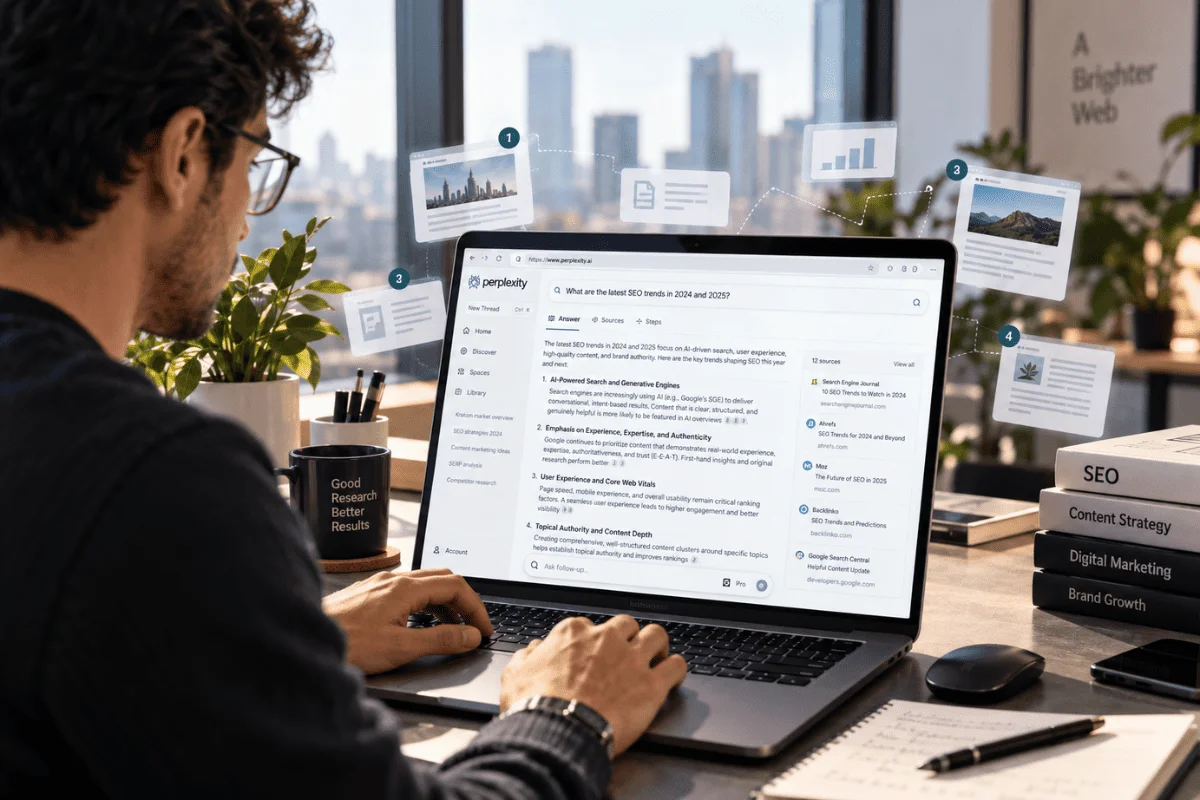
3) Perplexity result, captured July 2026. The visible answer surfaced Onely, Envigo, RepIndia, and White Bunnie, with source-linked support inside the response.
Platform | Agencies Visible in Capture | What Stood Out |
ChatGPT | iPullRank, NP Digital | Evaluated both SEO depth and AI visibility capability |
Google AI Overview | Directive Consulting, ZeroClik Labs, uSERP | Connected recommendations with entity optimization, Digital PR, and conversational content |
Perplexity | Onely, Envigo, RepIndia, White Bunnie | Showed a distinct shortlist with source-linked support |
The 90-Day AI Search Optimization Plan I Would Use
I would not try to fix everything at once. I would split the work into three focused phases:
Days 1–30: Build the foundation
Audit technical SEO, map the prompts your audience actually asks, and record your current AI visibility.
Days 31–60: Improve priority content
Rewrite important pages with clearer answers, stronger evidence, better structure, and more useful examples.
Days 61–90: Expand authority and track results
Earn relevant brand mentions, publish assets worth referencing, and monitor citations, prompts, and competitor visibility.
First become discoverable, then become useful, then become worth citing.
For agencies managing this across multiple clients, the challenge is often execution capacity as much as strategy. That is where a white-label SEO partner can make the model easier to scale.
What Content Has the Best Chance of Earning AI Visibility?
There is no universal winning format. But I prioritize pages with a strong reason to exist.
1. Clear definition pages
Useful for:
What is X?
What does X mean?
How does X work?
Include:
direct definition
mechanism
example
limitation
related concepts
2. Comparison pages
Useful for:
X vs Y
alternatives
product decisions
Include:
immediate verdict
comparison table
best for each audience
tradeoffs
selection criteria
3. Original research
Useful for:
citations
PR
authority
differentiated evidence
This is also where I look at real campaign results rather than theory alone.
Include:
methodology
sample size
collection date
limitations
downloadable data where appropriate
4. First-hand guides
Useful for:
implementation
tools
services
workflows
Include:
screenshots
actual steps
mistakes
exceptions
observations
5. Decision content
Useful for:
commercial research
complex products
service selection
Include:
who it is for
who it is not for
cost
tradeoffs
risks
alternatives
6. Expert commentary
Useful for:
fast-moving markets
emerging technology
strategic interpretation
Include:
named author
real expertise
clear argument
evidence
Limitations
7. Visual and Multimodal Assets
Useful for:
complex processes
original data
comparisons
platform-wide discovery
Include:
charts
original infographics
diagrams
short videos
clear captions
descriptive alt text
Traditional SEO is not dead. But the scoreboard has changed. Do not try to trick AI into mentioning your brand. Build the clearest, most useful, best-supported version of your expertise. Make it technically discoverable. Give other people genuine reasons to reference it. Then measure whether your brand is starting to enter the answers that matter.
Have questions about where your brand stands in AI search right now? That's the exact audit my team runs first with every new client, happy to compare notes.
FAQs
1. What's the difference between SEO, AEO, and GEO?
SEO optimizes for ranking position in a list of links, measured by clicks, rankings, and backlinks. AEO optimizes for direct answers like featured snippets and People Also Ask, measured by snippet ownership. GEO optimizes for being cited or mentioned inside an AI-generated answer, measured by citation frequency and brand mentions. See the full comparison table above, or the complete SEO vs GEO vs AEO guide for a deeper breakdown.
2. Does ranking well on Google guarantee my brand gets cited by AI?
No. Ahrefs' March 2026 study of roughly 863,000 keyword SERPs found that only 37.1% of cited AI Overview URLs ranked in Google's organic top 10, while 36.7% didn't rank in the top 100 at all. Traditional rankings still matter, but the relationship to AI citation isn't one-to-one.
3. How long does AI search optimization take to show results?
A realistic starting timeline is about 90 days, broken into three phases: the first 30 days for a technical and visibility audit, days 31–60 for rewriting priority content with stronger evidence and structure, and days 61–90 for earning mentions and tracking citations. That's a foundation-building window, not a guarantee of a specific result by day 90.
4. What kind of content is most likely to get cited by AI systems?
Content with a strong, specific reason to exist tends to perform best: clear definition pages, comparison pages with a real verdict, original research with a stated methodology, first-hand implementation guides, and decision-focused content that names who something is and isn't for. Generic, surface-level articles repeating the same points as competitors give a retrieval system little reason to prefer them.