A few years ago, search visibility was relatively easy to describe. Someone typed a query into Google, a ranked list of pages appeared, and SEO focused on helping your business move higher in those results.
That journey is now far less linear.
A potential customer might search Google, read a featured answer, encounter an AI overview, ask ChatGPT for recommendations, compare options in Perplexity, and then refine the question with additional context around budget, industry, location, or use case.
Read more: How to rank in ChatGPT search?
The strategic question, therefore, is no longer simple.
How do we rank?
It is increasingly
How do we become discoverable, understandable, and worth surfacing across different search experiences?
This is where SEO, AEO, and GEO enter the conversation. The three are often presented as separate disciplines, each with its own acronym, tactics, and playbook. I think that framing is too neat.
They overlap far more than most comparison charts suggest, because all three depend on useful information, technical accessibility, relevance, authority, and trust. But they are not completely interchangeable either. A page that ranks well in Google is not automatically the page an AI system will cite. A concise answer may be easy to extract without making the brand itself more likely to be recommended. And strong visibility in one search environment does not guarantee the same outcome in another.
So, the real SEO vs GEO vs AEO discussion is not about choosing the newest acronym. It is about understanding how discovery is changing, where the three approaches genuinely differ, and how businesses should adapt without building three disconnected strategies for the same customer journey.
What Is SEO?
SEO, or search engine optimization, is the process of improving a website’s visibility in organic search results so the right people can discover it when they are actively looking for information, products, services, or solutions.
That definition sounds straightforward, but SEO has never been one tactic.
1. SEO Starts With Discovery and Understanding
Before a page can compete in search results, search engines need to access it, interpret it, and understand how it fits within the wider website.
Crawlability and indexation
Clear site architecture
Logical internal linking
Strong topical relationships
2. SEO Depends on Relevance and Authority
Being accessible is not enough. A page must align with real search demand, satisfy intent, provide useful content, and demonstrate enough credibility to compete.
Search intent alignment
Content quality and depth
Relevant external links
User experience and trust signals
3. The Real SEO Outcome Is Qualified Discovery
The traditional SEO journey moves from a query to a ranked result and then to a website visit, but rankings are only an intermediate metric.
Search visibility
Qualified organic clicks
Relevant audience reach
Conversions and business outcomes
Query → Search Results → Ranking → Click → Website
I have always thought reducing SEO to “ranking higher” misses the commercial point. The real goal is being discovered by the right person, for the right need, at the right stage in the decision-making process.
What Is AEO?
AEO, or answer engine optimization, focuses on making information easier for search and AI systems to retrieve, understand, and use when responding directly to a question.
1. AEO Means Answer Engine Optimization
There is no universally agreed boundary around AEO. In this guide, I use it to describe the work of making information more usable in direct answers.
Clear, self-contained answers
Explicit definitions and explanations
Strong question-to-answer alignment
Information that can be retrieved with minimal ambiguity
2. AEO Changes How Content Is Structured
AEO does not mean making content shorter. It means making important information easier to identify while preserving enough depth to support confidence and context.
Direct answer blocks
Concise summaries
Clear semantic relationships
Supporting evidence and deeper explanation
3. AEO Is Not “Add an FAQ Section”
A weak AEO strategy adds generic FAQs everywhere. A stronger one understands the user’s actual decision, resolves the immediate question, and anticipates what comes next.
Answer the core question early
Cover likely follow-up questions
Make supporting evidence easy to find
Structure content around real decision paths
I think this distinction matters because AEO is often reduced to formatting. The real opportunity is not to create more question headings. It is to make useful information easier to understand, retrieve, and trust.
What Is GEO?
GEO, or generative engine optimization, focuses on improving the accuracy and prominence with which a brand, product, entity, or source is represented in AI-generated responses.
1. GEO Means Generative Engine Optimization
GEO looks beyond traditional rankings and focuses on whether AI systems can understand, retrieve, and meaningfully include your brand or information in generated responses.
Brand mentions in AI answers
Source citations and references
Inclusion in comparisons
Visibility in recommendations
2. GEO Changes the Visibility Model
Traditional SEO often competes for a ranked position. GEO operates in environments where information may be retrieved, synthesized, compared, cited, or omitted entirely.
Prompt and context influence outputs
Multiple sources may shape one answer
Citations and mentions are separate outcomes
Recommendations may change as constraints change
Prompt → Retrieval / Context → Synthesis → Generated Answer → Citation or Recommendation
3. GEO Is Not Simply “SEO for ChatGPT”
That phrase is useful as shorthand, but it oversimplifies how generative discovery works across different systems, prompts, contexts, and user requirements.
There is no single universal AI ranking
Different systems may retrieve differently
Prompt context can change brand relevance
Citation and recommendation are not the same outcome
I think this is where the GEO vs SEO difference becomes most important. SEO often asks where a page appears. GEO asks whether a brand or source belongs in the answer being constructed.
Where SEO, AEO, and GEO Genuinely Diverge
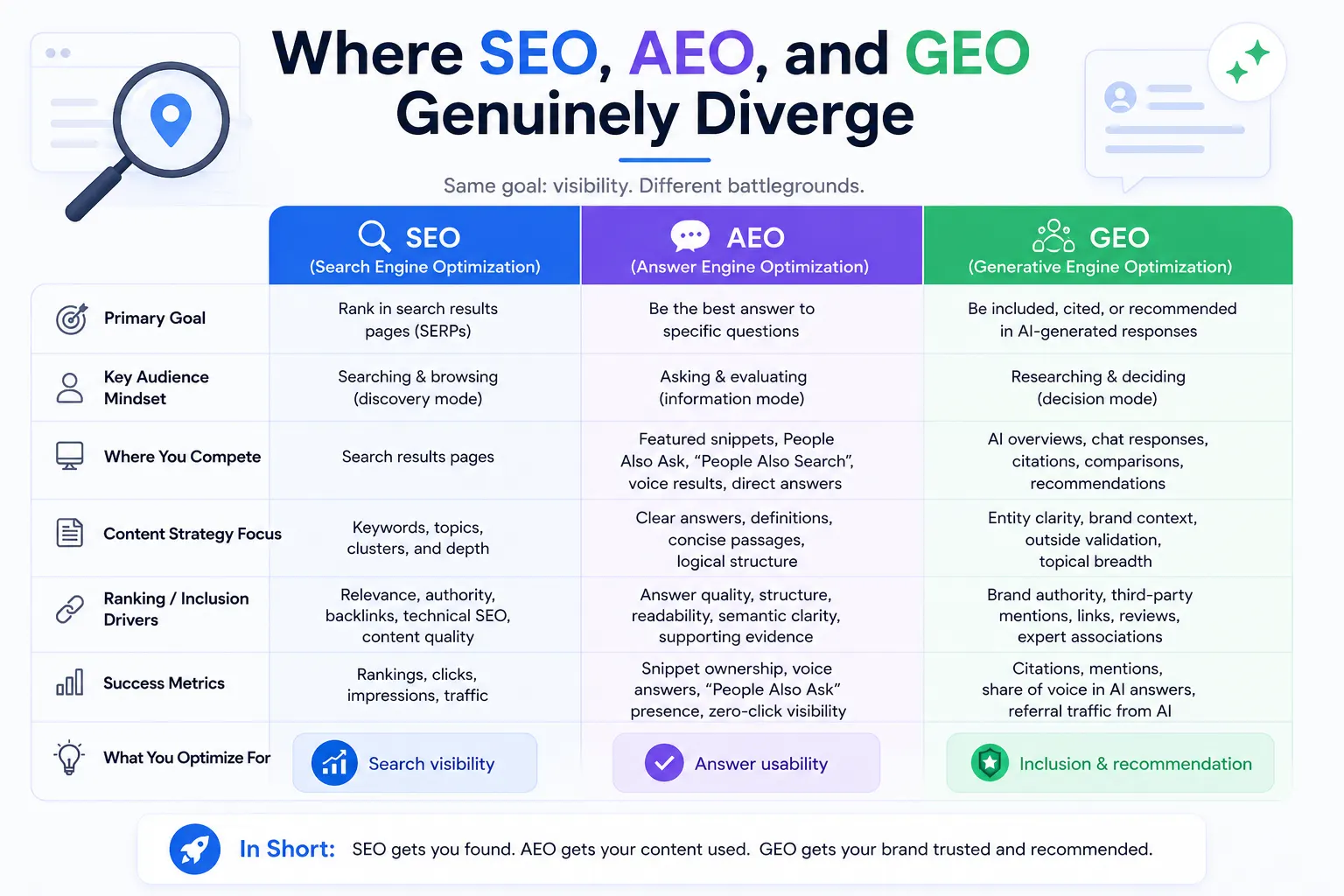
SEO, AEO, and GEO share many foundations, but they differ in what visibility looks like, what competes for inclusion, and how success should be measured.
Strategic Question | SEO | AEO | GEO |
What are we trying to win? | Search visibility | Answer inclusion | Generated representation |
What is the unit of competition? | Page or result | Answer passage or source | Brand, entity, source, or evidence set |
How does context behave? | Often query-specific | Question-specific | Can accumulate conversationally |
Is a click required? | Often desired | Not necessarily | Not necessarily |
What do we measure? | Rankings, clicks, conversions | Answer presence and extraction | Mentions, citations, and recommendation sharing |
Where does authority matter? | Page and domain strength | Confidence in the answer and source | Wider evidence around the brand or entity |
The practical difference is that SEO usually makes it easier to locate a page: a page appears in a search result. AEO asks whether the information is suitable for a direct answer. GEO adds another layer by asking whether a brand, source, or body of evidence is represented in an AI system's response.
That is why I would not treat the three as interchangeable. The foundations overlap, but the competitive outcome changes.
How Do You Do Search Engine Optimization?
Search Engine Optimization (SEO) is the practice of improving your website’s visibility in search engine results so that people can find, understand, and engage with your content. The goal is not just to rank for keywords, but to create a strong, connected presence that performs well across search results and supports user intent.
1. Start With Real Search and Decision Journeys
Map how customers move from initial discovery to deeper research and comparison. Look beyond keywords and identify the questions, needs, and follow-up searches that shape decisions.
High-intent search queries
Repeated customer questions
Comparison and alternative searches
Informational and transactional search intent
2. Build Content That Is Easy to Find and Use
Your website needs strong SEO foundations, but content should also be clear, structured, and useful for both users and search engines.
Crawlable and indexable pages
Clear headings, definitions, and summaries
Strong internal linking between related topics
Supporting evidence and relevant details
3. Strengthen Visibility Beyond Your Own Website
SEO is not limited to your own site. External signals help search engines understand your authority and relevance.
Relevant editorial mentions
Authoritative backlinks
Digital PR coverage
Reviews and third-party references
4. Measure SEO Performance Effectively
Track performance by how users find and interact with your content via search engines.
Rankings for target keywords
Organic traffic and click-through rates
Engagement metrics such as time on page
Conversions from organic search
My view is that search engine optimization is less about chasing rankings and more about building a website that is consistently discoverable, useful, and trustworthy for users searching for answers.
Businesses Need One Search Visibility Strategy, Not Three Competing Playbooks
SEO, AEO, and GEO are often discussed as separate disciplines, but businesses do not need three disconnected strategies. A stronger approach is to build one visibility system around three connected layers: discovery, understanding, and credibility.
Layer 1: Be Discoverable
The first layer is ensuring that search engines can access, understand, and surface the right pages for relevant demand and user intent.
Crawlability and indexation
Clear site architecture
Search demand and intent alignment
Useful pages connected through internal links
Layer 2: Be Understandable
The second layer is making important information easy to interpret, retrieve, and use when answering questions or summarizing a topic.
Clear answers and explicit definitions
Extractable passages and concise summaries
Logical content structure
Supporting evidence and follow-up coverage
Layer 3: Be Credible Beyond Your Own Website
The third layer extends beyond owned content. Wider recognition can reinforce what a brand is known for, where it is relevant, and why it deserves consideration.
Relevant links and editorial mentions
Digital PR and expert references
Independent comparisons and reviews
Consistent brand information across the web
The distinction is simple:
SEO helps a business become discoverable. AEO helps its information become usable. GEO asks whether the wider evidence around the brand makes it worth including.
That is why the strongest strategy is not to build three isolated playbooks. It is to create one connected visibility system in which technical accessibility, useful content, clear answers, authority, and external validation reinforce one another.
Does Every Business Need SEO, AEO, and GEO?
Not every business needs to invest equally in SEO, AEO, and GEO. The right priority depends on how customers discover the brand, evaluate options, and make decisions.
1. Prioritize SEO When
SEO should remain the priority when customers actively search for the category and organic visibility plays a meaningful role in generating traffic, leads, or sales.
Existing search demand is strong
Customers regularly use search engines
Organic acquisition supports business growth
Core website discoverability remains weak
2. Add Stronger AEO Thinking When
AEO becomes more important when customers require clear explanations, direct answers, or comparisons before they can confidently move forward.
Customers ask repeated questions
The category is complex or unfamiliar
Comparisons influence decision-making
Direct-answer interfaces shape discovery
3. Invest More Heavily in GEO When
GEO deserves greater attention when AI-generated recommendations influence consideration and external evidence plays a significant role in how brands are evaluated.
Recommendations influence purchase decisions
AI discovery can be measured
Competitors already appear in answer engines
Third-party authority affects brand selection
The buying journey involves extensive research
Most established businesses do not need to choose one acronym and ignore the others. They need to identify which visibility gaps are commercially important and invest in ways that align with how their customers actually search, evaluate, and decide.
SEO vs GEO vs AEO: Final Takeaway
The difference between SEO, AEO, and GEO matters, but not because businesses need three disconnected strategies.
The real opportunity is in how these disciplines work together. Technical accessibility still matters. Clear answers still matter. Authority, evidence, and wider recognition matter even more as discovery expands beyond ranked search results.
Businesses should focus on building a presence that can be found, understood, verified, and surfaced across different environments. That means publishing content around real decisions, supporting important claims with credible evidence, strengthening recognition beyond the website, and measuring visibility across both traditional search and AI-driven discovery.
The interfaces will continue to change. New platforms, formats, and acronyms will appear.
The underlying advantage will remain much more consistent: brands that are easy to find, easy to understand, and difficult to ignore will be better positioned wherever the customer journey begins.
Frequently Asked Questions
1. What Is the Main Difference Between SEO, GEO, and AEO?
SEO focuses on improving visibility in search results, AEO makes information easier to use in direct answers, and GEO improves how brands, sources, and evidence are represented in AI-generated responses. Their foundations overlap, but the desired visibility outcome differs.
2. Is GEO Replacing SEO?
No. GEO is not replacing SEO. Strong AI visibility still depends on many traditional SEO foundations, including crawlability, useful content, authority, and relevance. GEO expands the strategy by focusing on mentions, citations, comparisons, and recommendations within generative search environments.
3. What Is SEO vs. GEO?
SEO primarily focuses on earning visibility through ranked search results, while GEO focuses on inclusion in AI-generated answers. SEO typically measures rankings, clicks, and conversions. GEO looks more closely at brand mentions, citations, recommendation frequency, and representation across contextual prompts.
4. What Is the Difference Between AEO and GEO?
AEO focuses on making information clear, retrievable, and suitable for direct answers. GEO focuses more broadly on whether a brand, source, or evidence set is included in an AI-generated response, comparison, citation, or recommendation.
5. Do I Need AEO, SEO, and GEO?
Most businesses benefit from elements of all three, but investment should not be equal by default. Priorities should depend on existing search demand, customer questions, AI-driven discovery, competitive visibility, and the role that organic and recommendation-based channels play in revenue.
6. How Do SEO, AEO, and GEO Work Together in One Strategy?
Rather than three separate playbooks, they map onto three connected layers: being discoverable (crawlability and site structure), being understandable (clear answers and extractable content), and being credible beyond your own website (digital PR, reviews, and consistent brand information). Strengthening one layer tends to reinforce the others.
7. How Do You Measure Success Differently Across SEO, AEO, and GEO?
SEO is typically measured through rankings, organic clicks, and conversions. AEO is measured by whether your content actually gets used as a direct answer or extracted passage. GEO is measured by mentions, citations, and how often a brand is recommended inside AI-generated responses — outcomes that don't require a click at all.
8. Does a High Google Ranking Guarantee GEO Visibility?
No. As the article notes above, a page that ranks well in Google is not automatically the page an AI system chooses to cite. GEO depends on whether a brand or source is understood, retrieved, and judged worth including in a generated answer, which is a separate outcome from ranking position.