How To Rank In Perplexity: A Complete Guide to AI Search Visibility
To rank in Perplexity, you must optimize your content to be cited as a trusted source within AI-generated answers rather than competing for traditional page-one blue links. Perplexity reads full user queries, crawls live web pages, extracts relevant passages, and provides synthesized answers accompanied by direct citations.
Ranking in Perplexity AI requires a fundamental shift in strategy. While traditional search rewards the page that earns the click, ranking higher in Perplexity means focusing on satisfying user intent clearly enough to be quoted in the answer. Although Perplexity still handles a smaller slice of overall search volume compared to Google, its growth has surged from 230 million monthly queries to more than 780 million in under a year.
What Is Perplexity AI and How Does It Work?
Perplexity is an AI-powered answer engine. It reads a full question, searches the live web, and generates a direct, conversational response instead of handing you a list of blue links. Depending on the mode someone picks, it can call on models like Claude or GPT-5 to interpret the question and shape the answer. Google gives you ten results to click through and sort out yourself. Perplexity does that reading for you and shows exactly which sources it leaned on, right at the top of the response.
How Perplexity Uses AI Search and Retrieval-Augmented Generation (RAG) and How It Cites
Perplexity uses Retrieval-Augmented Generation (RAG) to deliver real-time, accurate answers by combining live web search with generative AI models.
Instead of relying solely on pre-trained knowledge, it searches the live web, pulls the most relevant passages, and synthesizes a concise answer backed by direct citations.
How the RAG Process Works
[User Query] ➔ [Live Web Search] ➔ [Passage Extraction] ➔ [AI Synthesis & Citation] |
Query Processing: Perplexity interprets the full conversational context of a user's question.
Live Retrieval: It queries search indexes to fetch fresh, topically relevant web pages.
Passage Extraction: The system parses those pages, isolating specific sentences or data points that directly answer the query.
Synthesis & Citation: The LLM generates a cohesive summary and anchors key facts with numbered inline citation links.
What Determines Which Sources Get Cited?
Perplexity does not cite every page it crawls. To select citations, its algorithms prioritize four key criteria:
Direct Answer Placement: Pages that answer the query in the very first sentence of a section are significantly easier for RAG models to extract.
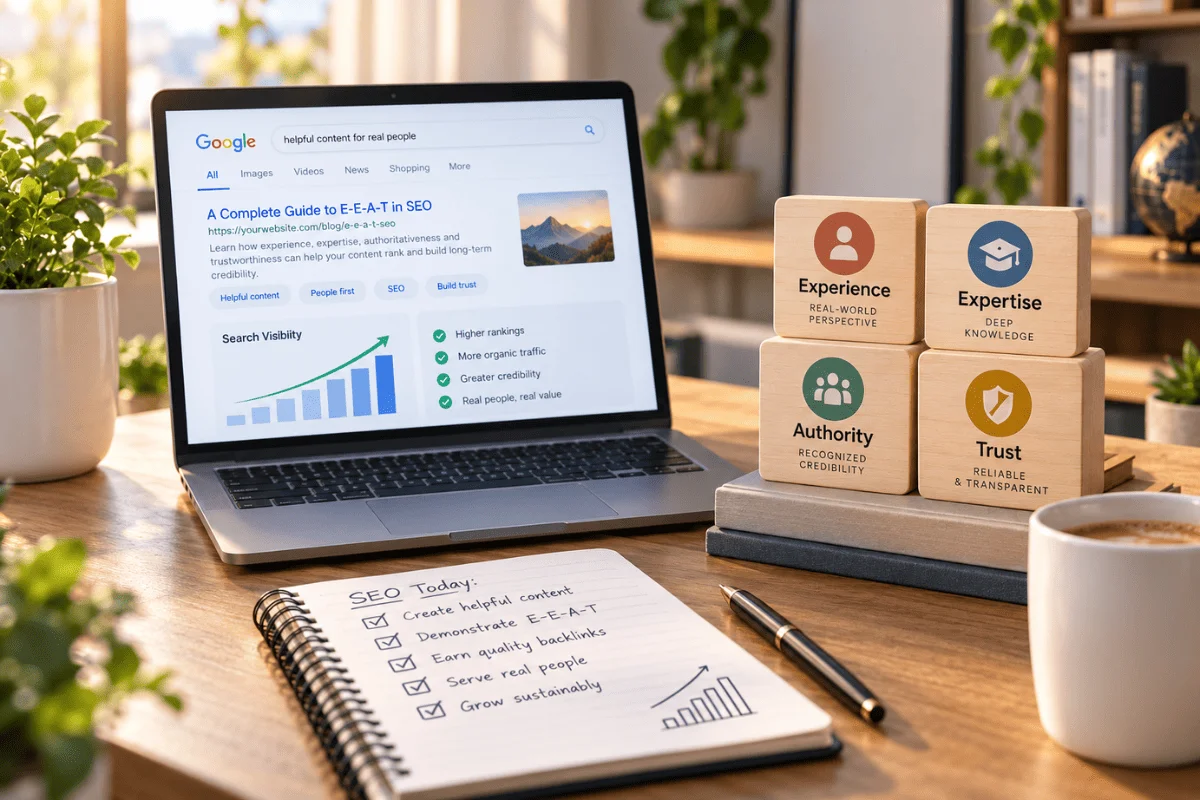
Domain Trust & Authority: High E-E-A-T signals, strong link profiles, and recognized brand authority increase citation probability.
Content Freshness: Regularly updated pages are favored for time-sensitive queries over stale, legacy content.
AI Readability: Clear headings, short paragraphs, bullet points, and concise text allow parsers to process facts without noise
What We Know vs. What We Infer Perplexity does not publish a complete ranking algorithm for citations. Some practices in this guide come directly from Perplexity's documentation, while others are supported by academic research, third-party studies, or repeatable observations. Treat GEO as an optimization process rather than a guaranteed ranking formula. |
How Is Perplexity Ranking Different From Traditional SEO?
Google rewards the page that satisfies intent well enough to earn the click. Perplexity rewards the page that satisfies intent well enough to get quoted inside someone else's answer, whether the reader ever clicks through or not.
Here's the difference broken down:
Signal | Google Search | Perplexity |
What wins | The page that earns the click | The page that earns the citation |
Success looks like | Ranking position 1-10 | Being quoted inside the answer |
Content length | Often rewards depth and length | Rewards a clean, direct answer up front |
Click required? | Yes, to see the full page | No, the answer can satisfy without a click |
From Ranking Pages to Earning AI Citations
Earning AI citations requires creating standalone content passages that retain context, accuracy, and clear value when extracted from your page. Instead of structuring pages purely to rank for target keywords, you must curate self-contained answers that an AI engine can confidently reference without additional clarification.
The Role of SEO, AEO, and GEO in Perplexity Visibility
Combining SEO, AEO, and GEO creates the ideal foundation for maximum visibility in AI search engines.
SEO (Search Engine Optimization): Provides the technical base, including page speed, site architecture, and link building.
AEO (Answer Engine Optimization): Focuses on query intent matching, Q&A formatting, and clear heading hierarchy.
GEO (Generative Engine Optimization): Tailors content specifically for AI summarization, quote extraction, and entity recognition.
How to Rank in Perplexity: 8 Optimization Strategies
1. Target Exact Conversational Questions
Why It Matters: Perplexity users search with full conversational queries rather than short keyword fragments. Broad sales pages (e.g., "SEO Services") rarely get cited for specific questions like "How do I get my agency's blog cited in AI search?"
How to Optimize:
Frame section subheadings around precise long-tail questions buyers ask.
Place a direct, single-sentence answer in the very first line under every heading before elaborating.
2. Structure Content for AI Extraction
Why It Matters: LLMs extract structured passages far more accurately than dense walls of text. Clean formatting makes it easy for RAG engines to lift answers verbatim.
How to Optimize:
Break information into short paragraphs, bullet points, and concise HTML tables.
Use FAQ sections formatted with schema to mark up direct questions and answers.
3. Publish Original Data, Research, and Expert Insights
Why It Matters: LLMs easily summarize standard, generic advice without needing to cite a specific source. Proprietary information forces AI engines to attribute the original source directly to your site.
How to Optimize:
Include at least one original stat, survey finding, client metric, or expert quote per article.
Hyperlink all external statistics directly to primary research and official datasets.
4. Build Strong E-E-A-T & Search Authority Signals
Source | Finding |
BrightEdge | 60% of Perplexity's citations overlap with the top 10 Google results for the same query |
FirstPageSage (2024) | "Best of" / "top X" list features drive 64% of Perplexity's general recommendation weighting |
FirstPageSage (2024) | Reviews account for 31% of that weighting; awards or affiliations account for just 5% |
5. Optimize for Community Discussions on Reddit
Why It Matters: Reddit is Perplexity’s single largest citation source, representing 46.7% of its top citations (compared to ChatGPT's top source, Wikipedia, at 47.9%).
How to Optimize:
Participate authentically in relevant subreddits (e.g., r/SEO, r/marketing, r/SaaS).
Answer user questions directly without overt sales language, allowing organic upvotes to signal community validation to AI crawlers.
Platform | Top Cited Source | Reddit's Share |
Perplexity | Reddit (46.7%) | 46.7% |
ChatGPT | Wikipedia (47.9%) | 11.3% |
6. Build Topic Authority Through Content Clusters
Why It Matters: A single isolated article rarely proves overall domain depth. Perplexity favors sites that show comprehensive coverage across an entire subject area.
How to Optimize:
Develop a comprehensive pillar page around a core topic.
Link cluster articles together using descriptive, context-rich anchor text.
7. Maintain Freshness & Citation Integrity
Why It Matters: Perplexity’s RAG pipeline prioritizes updated content to avoid generating stale or disproven facts. Stale pages lose citation priority as topics evolve.
How to Optimize:
Audit cornerstone pages every 3 to 6 months to refresh statistics, dead links, and outdated examples.
Update the publication and modified schema timestamps whenever making substantive edits.
8. Ensure Technical SEO & AI Crawlability
Why It Matters: All content optimization fails if AI crawlers cannot access or index your pages properly.
How to Optimize:
Verify that robots.txt explicitly allows PerplexityBot.
Add an llms.txt file to your root directory to guide AI models toward your highest-value pages.
Maintain clean XML sitemaps and fast load times over HTTPS.
How to Track Perplexity Visibility
Tracking Perplexity performance requires monitoring manual brand citations and analyzing isolated AI referral traffic.
Define Target Queries] ➔ [Periodic Citation Checks] ➔ [GA4 Referral Segment] ➔ Conversion Analysis |
Monitor AI Citations Manually: Compile a list of target buyer queries, run them periodically in Perplexity, and log whether your domain is cited.
Track GA4 Referral Traffic: Set up custom regex filters in Google Analytics 4 to track visitors arriving from perplexity.ai.
Evaluate AI Visibility Tools: Use specialized enterprise tracking platforms once manual tracking becomes too time-consuming.
Common Mistakes That Hurt Perplexity Rankings
Mistake | Why It Hurts You |
Creating generic content without original value | Reads like a summary of five other articles, so Perplexity has no reason to cite you over the originals |
Ignoring sources, citations, and trust signals | Claims with no backing and no credentialed author sink lower in Perplexity's trust hierarchy |
Writing only for keywords instead of user intent | Keyword-stuffed pages with no direct answer struggle in Perplexity even if they still rank fine on Google |
A Perplexity Ranking Checklist
Use this quick reference list before publishing any new piece of content:
Answer the exact question directly in the first sentence under key subheadings.
Format headings as real conversational queries in Title Case.
Break up dense text into bulleted lists and clean HTML tables.
Include at least one original stat, case study metric, or expert quote.
Hyperlink external stats directly to original primary sources.
Confirm robots.txt permits PerplexityBot crawling and add an llms.txt file.
Share helpful insights on relevant subreddits like r/SEO or r/marketing.
Set a 3-to-6-month content refresh schedule for cornerstone pages.
Track citations manually and isolate perplexity.ai referral traffic in GA4.
FAQs
How long does it take to appear in Perplexity citations?
There is no fixed timeline. Citation visibility can change as pages are crawled, updated, retrieved for different prompts, and compared with other available sources. Track a consistent set of prompts over time rather than relying on a universal timeframe.
Do backlinks still matter if Perplexity doesn't rank pages the way Google does?
Yes, they do. Backlinks still work as a trust signal, since that overlap between Perplexity's citations and Google's top results suggests both systems are leaning on a lot of the same authority markers, even if the final output looks completely different.
Can a small business realistically get cited without a big content team?
Yes, and honestly it's often easier than competing on Google. One well-structured, specific page with a real original insight can beat a much bigger site's generic version of the same topic.
Is there a way to guarantee a citation in Perplexity?
No, and I'd be pretty skeptical of anyone who tells you otherwise. What you actually can do is stack the odds consistently in your favor using the strategies in this guide.
Final Thoughts
Ranking in Perplexity isn't about gaming an algorithm or packing keywords onto a page. It comes down to clarity, credibility, and accessibility. By answering questions directly up front, backing up claims with real data, and maintaining a site that AI crawlers can easily parse, you position your brand to become an authoritative source that AI search engines rely on every day.