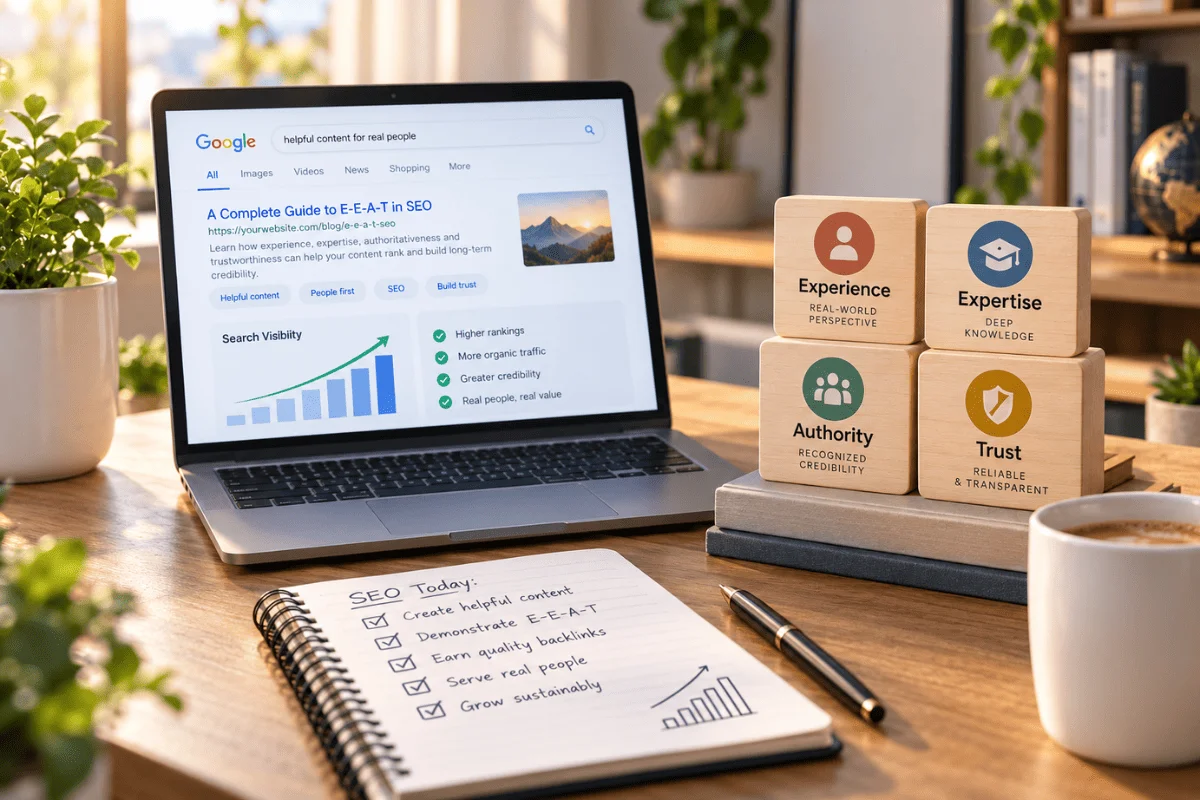
You increase organic traffic by matching content to real search intent, building topical depth through clusters, fixing on-page SEO basics, and refreshing what's already ranking instead of only publishing new pages. Do that consistently, and unpaid visitors keep showing up long after paid ads stop.
I've noticed that sites that grow without big swings usually repeat a few habits: they publish helpful content, keep their SEO setup solid, use internal links clearly, and keep improving what already exists. This article walks through ways to grow organic traffic, highlights what often limits results, and shows how to check whether your plan is paying off.
Key Takeaways
• Organic traffic is unpaid visitors from search results traffic you earn through relevance, not rent through ad spend.
• It compounds over time, unlike paid traffic, which stops the moment the budget runs out.
• Matching content to search intent matters more than chasing keyword volume alone.
• Topic clusters (a pillar page plus supporting content, linked together) build stronger topical authority than random posts.
• On-page basics title tags, headings, alt text, page speed still remove real barriers to ranking.
• Refreshing decaying content often recovers lost traffic faster than publishing something new.
• AI Overviews and answer engines are now part of organic visibility, not separate from it.
• Track impressions, clicks, rankings, and conversions together, not any single metric alone.
How to Increase Organic Traffic on Your Website: Quick Answer
Do This | Why It Works |
Target keywords by search intent, not just volume | Matches content to what searchers actually want |
Build topic clusters, not random posts | Signals topical authority to Google |
Write content that answers the question fast | Improves rankings and AI citations |
Fix on-page SEO basics | Removes technical barriers to ranking |
Refresh decaying content regularly | Recovers lost rankings without new content |
Add structured data | Helps search engines understand and feature your content |
Build internal links strategically | Distributes authority across your site |
What Is Organic Traffic?
Organic traffic is the visitors your website gets from unpaid search results. In other words, someone searches for something on Google, Bing, or an AI-powered search platform, finds your page, and clicks through without you paying for that visit.
I like to think of organic traffic as traffic you earn, not rent. You’re not paying for every click; you’re earning visibility by creating content that search engines see as relevant and useful.
Organic Traffic vs Paid Traffic
Factor | Organic Traffic | Paid Traffic |
Cost | Free per click, but takes time/effort upfront | Pay per click or impression |
Longevity | Keeps working after you stop actively promoting | Stops the moment budget runs out |
Trust factor | Feels more credible to users | Clearly marked as an ad |
Speed to results | Slower, often weeks to months | Immediate |
Scalability | Compounds over time | Scales only with budget |
Strategies to Increase Website Traffic
1. Understand What Your Audience Is Actually Searching For
A strong article can still miss the mark if it targets the wrong search intent. Before I start writing, I try to understand what the person behind the query is actually hoping to find.
Identify the Search Intent Behind Each Keyword
Match the content type to that goal. A search like “best X” usually calls for a comparison or list, while a “what is X” query needs a clear explanation.
Analyze the Current SERP Before Creating Content
Review the pages already ranking in the top results.
Pay attention to the format, depth, and angle they use.
Look for something they missed, rushed through, or failed to explain clearly.
2. Find Keywords That Can Actually Bring Organic Traffic
Not every keyword deserves your time. I would rather rank well for a smaller search term that attracts the right audience than chase a high-volume keyword that brings little value.
Target Long-Tail and Low-Competition Keywords
Long-tail searches are usually more specific, which often makes the intent easier to understand.
They can also be more realistic targets for newer websites or sites competing in crowded niches.
Look Beyond Search Volume to Traffic Potential
A keyword with modest search volume can still be valuable if it sits inside a larger topic that attracts steady traffic.
Check how much traffic the top-ranking page receives overall, not just the volume attached to one keyword.
Identify Emerging and Trending Keywords
Use trend data to spot topics that are starting to gain attention.
Getting useful content published early can give you a head start before the space becomes more competitive.
3. Build Topic Clusters Instead of Publishing Random Blog Posts
Publishing unrelated articles may bring occasional traffic, but it does little to build depth around a subject. Topic clusters create a much stronger foundation.
Create Pillar Pages Around Core Topics
Choose a broad subject that matters to your audience and create a detailed page that covers it thoroughly.
Support Them With Cluster Content
Build smaller articles around related questions, subtopics, and narrower search terms.
Connect Related Pages With Internal Links
Link supporting articles back to the main pillar page and connect related pages where it makes sense.
Use anchor text that clearly tells readers what they will find next.
4. Create Content That Deserves to Rank
SEO can help a page get discovered, but the content still has to earn its place. If the page is vague, repetitive, or unhelpful, rankings are unlikely to hold.
5. Optimize Your Content for Answer Engines and AI Search
Search no longer ends at traditional blue links. AI-powered results are becoming another place where brands can earn visibility, so I now treat answer-engine optimization as part of the broader SEO process.
6. Improve Your On-Page SEO
The fundamentals still matter. Even great content can struggle if the basic page setup is weak.
Title tags and meta descriptions need to be unique on every page. Pick just one H1 for the main topic.
Then use H2 for the main sections. Add H3 under those where it fits. For images, write clear alt text that explains what the image shows. Also use file names that match the image topic, like “blue-widget.jpg” instead of “img_001.jpg”
. Keep page URLs short. Make them easy to scan and make sure they match what the page is about.
Make sure slow load times or a poor mobile experience are not getting in the way.
7. Strengthen Your Internal Linking Strategy
Internal links help readers find your content and give search engines a clearer understanding of how your pages relate.
Link from stronger pages to newer or underperforming content where the connection is relevant.
Use descriptive anchor text instead of vague phrases like “click here.”
Check regularly for orphan pages that have no internal links pointing to them.
Give extra attention to pages that are already close to reaching page one.
8. Refresh Content That Is Losing Organic Traffic
Older content does not always need to be replaced. In many cases, a thoughtful update works better than starting from scratch.
How to Identify Content Decay
Look for pages showing a gradual decline in clicks or impressions in Google Search Console.
Check whether competing pages have become more current, detailed, or useful.
What Should You Update?
Replace outdated statistics, examples, screenshots, and references.
Add useful subtopics that were not covered before.
Fix weak, broken, or outdated internal and external links.
9. Add Structured Data Where It Makes Sense
What Is Schema Markup?
Schema markup is structured code that gives search engines more clarity and depth about the content on a page. When used correctly, it can help pages qualify for certain enhanced search features.
Schema Types That Can Improve Search Visibility
FAQ schema for eligible question-and-answer content.
HowTo schema where the page genuinely follows a step-by-step process and current search guidelines support its use.
Article schema for blog posts and editorial content.
Review schema for eligible product or service review content.
10. Repurpose Successful Content Into Search-Friendly Formats
Content that already performs well can often be extended into other useful formats instead of being left as a single page.
Turn a strong article into something people can consume differently, like a video, infographic, podcast, or visual guide.
Pull out the most useful points for social media, then link back to the full piece for anyone who wants the complete answer.
Adapt the title, description, and supporting copy for each format instead of copying and pasting the same version everywhere.
How to Increase Organic Traffic Without Creating New Content
You do not always need to publish more pages to grow; some of the biggest gains I have seen come from improving what is already there.
You can:
Update and expand existing pages that already attract traffic.
Fix missing or weak internal links across the site.
Keep up with technical issues such as broken links, slow pages, and crawl problems.
Merge thin or overlapping pages into one stronger resource.
Add relevant structured data where it's missing.
Improve page titles and meta descriptions to encourage more clicks from search results.
Why Organic Traffic Matters for Long-Term Website Growth
Organic traffic can keep bringing people to your site without paying for every click. Unlike ads, which usually stop driving traffic when the budget ends, SEO can continue working over time.
Why Organic Traffic Matters
Long-term visibility: A well-optimized page can keep ranking and bringing visitors for months or even years.
Lower ongoing costs: SEO takes time and effort, but you are not charged every time someone clicks your result.
More brand trust: Showing up regularly for relevant searches can help people become more familiar with your brand and see it as a reliable option.
That is what makes organic traffic valuable: the work you do today can continue supporting your site later. Strategies to Increase Organic Traffic.
What Should You Avoid When Trying to Increase Organic Traffic?
Some SEO tactics can create more problems than progress. Avoid these common mistakes:
How to Measure Organic Traffic Growth
Do not judge organic growth by traffic alone. Look at a few signals together to see whether visibility, clicks, and results are improving.
Metric, What to Look For
Impressions: Are your pages appearing in search more often?
Organic clicks: Are more searchers visiting your website?
Keyword rankings: Are important keywords moving upward over time?
Organic CTR: Are people clicking when they see your result?
Landing page traffic: Which pages are gaining or losing organic visits?
Conversions: Are organic visitors signing up, buying, or completing key actions?
Non-branded traffic: Are new people discovering you through general searches?
AI mentions and citations: Is your site appearing in AI Overviews or other AI search results?
A Simple Way to Read the Data
Look at the metrics together, not separately. For example, deeper impressions with flat clicks may mean your visibility is improving, but your title or search result needs work. Rising traffic with no increase in conversions may mean you are attracting visitors from the wrong queries.
Tracking these patterns over time gives you a clearer picture of whether your organic traffic strategy is actually working.
Organic Traffic Growth Checklist
Mapped search intent for target keywords
Analyzed top-ranking SERP competitors
Built topic clusters around core themes
Answered the main query within the first 100 words
Added original data, examples, or experience
Structured content for AI/answer engines
Optimized title tags and meta descriptions
Fixed internal linking gaps
Refreshed decaying content
Added relevant schema markup
Repurposed top content into new formats
Set up tracking for clicks, rankings, and conversions
Frequently Asked Questions About Increasing Organic Traffic
How long does it take to see results from organic traffic strategies?
It usually takes time. Some websites start seeing movement within a few months, while others need longer, especially in crowded niches or when the site is still building authority. A three-to-six-month window is common, but it is better to watch the trend than expect results on a fixed date.
Can I increase organic traffic without link building?
Yes. Backlinks can help, but they are not the only way to grow. Better content, stronger internal links, cleaner on-page SEO, and regular updates can all make a noticeable difference, particularly if the site already has some visibility.
Does posting more frequently help organic traffic?
No, not on its own. Posting more can help, but only if every new page has a clear reason to exist and actually helps the reader. I would rather put out one solid piece than push out a bunch of quick posts that echo what is already there.
How much does AI search change traditional SEO?
AI SEO changes how people hunt for answers. Still, the core work stays the same. You have to figure out what folks are really trying to find. Then respond in a way that fits what they want. Also, help search engines feel confident in what you publish.
Is organic traffic still worth prioritizing over paid ads?
Yes, especially if you are thinking long-term. I see paid traffic as something you can switch on for quick visibility, while organic search is what helps build a more stable source of traffic over time.