For years, SEO was largely about getting your pages in front of the right people at the right time. We optimized keywords, improved technical performance, built links, and created content with one clear objective: earn a better position in search results. That foundation still matters, but the way people find information is changing.
Recent research shows marketers increasingly need to consider both AI-driven search experiences and traditional search channels rather than treating them as separate ecosystems.
Today, a customer can ask an AI search tool a detailed question and receive a synthesized answer instead of a list of pages to browse. That creates a different challenge for businesses: is your brand simply ranking somewhere, or is it being included, cited, and recommended in the answer?
That shift moves SEO beyond rankings and into retrieval, relevance, authority, and citation. This is where AI SEO strategies help businesses adapt their content, authority signals, and technical foundation for AI-driven search experiences. AI systems need to be able to:
Find your content when relevant questions are asked.
Understand your expertise and the topics your brand covers.
Extract useful answers from clearly structured content.
Verify and trust your information through evidence and authority signals.
Reference or recommend your brand when it fits the user's needs.
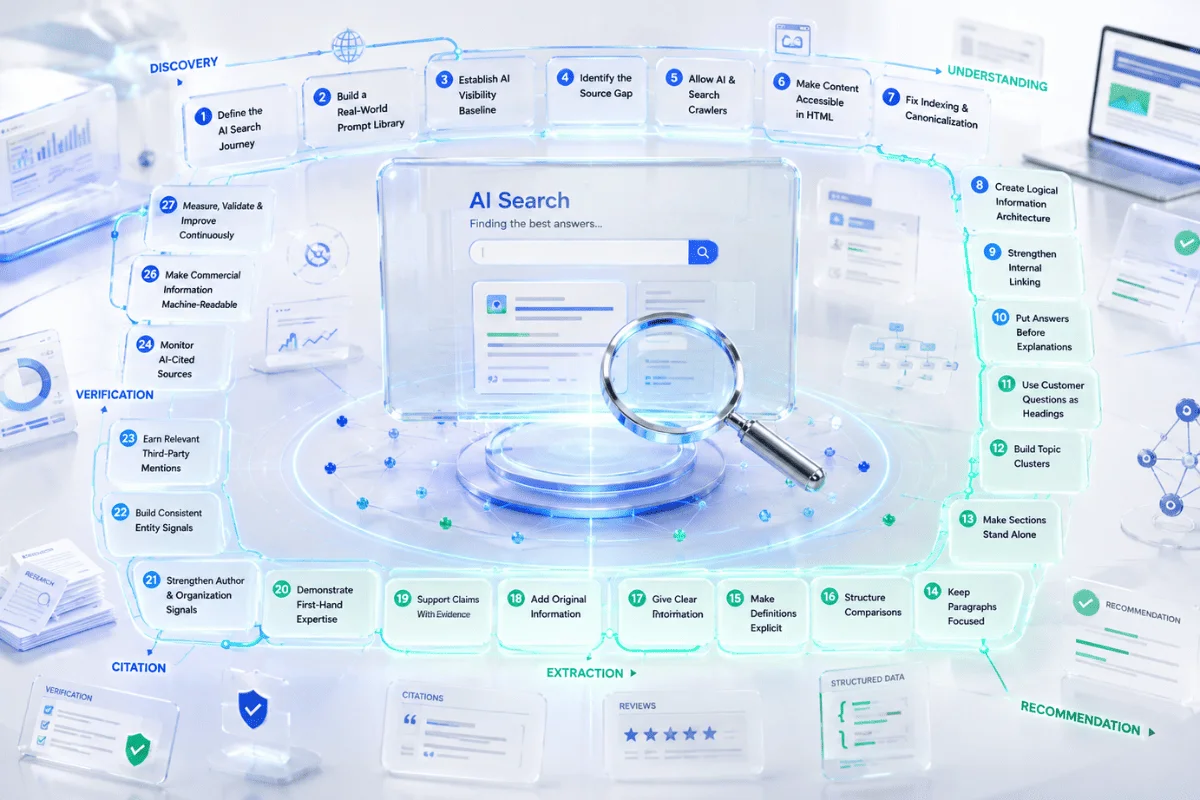
This 27-step AI SEO optimization checklist brings those pieces together, combining strong SEO fundamentals with GEO-focused content, technical authority, and measurement strategies.
Part 1—Build Your AI Search Visibility Strategy
Before optimizing content for AI search, you need to know where you actually want to be visible and what questions should lead customers to your brand. This is where GEO differs from traditional keyword research. Instead of asking only which keywords have search volume, look at the conversations, decisions, and problems that shape your customer's journey.
You don't need to track every possible AI prompt. You need to identify the questions that can influence your brand's visibility, reputation, and revenue, then build a system for understanding how AI platforms currently respond to those questions.
1. Define The AI Search Journey That Matters
Start with the question that actually matters to your business. A customer rarely goes from “I need a product” straight to a purchase. They may first ask what a solution is, compare different options, look for alternatives, check pricing, and eventually ask which company they should choose.
That means your AI SEO strategy should follow the entire decision journey, not just one commercial keyword. Think about what your customers need to know before they know your brand, while they compare options, and when they are ready to decide.
Here are the key areas to map:
Informational queries: What does the customer need to understand?
Comparison queries: What options are weighing against each other?
Recommendation queries: Which brands, products, or services are they considering?
Decision queries: What information could ultimately influence the purchase?
From a business perspective, this changes how you think about search demand. A high-volume keyword may bring traffic, but a specific question asked by someone comparing solutions can have far more commercial value. The goal is not to be visible everywhere. It is to be visible at the moments that can influence a buying decision.
2. Build A Real-World Prompt Library
Once you know the important customer journeys, turn them into a practical prompt library. Don’t rely entirely on keyword tools for this. Some of the most valuable AI searches may come from questions your customers are already asking your sales, support, and marketing teams.
Look through customer conversations, reviews, FAQs, support tickets, community discussions, and existing search data. Then turn those questions into natural prompts that reflect how someone would actually speak to an AI assistant.
Your prompt library can include:
Customer questions: What are people asking your team repeatedly?
Conversational queries: How would someone naturally phrase the problem?
Long-tail questions: What specific situations or requirements do customers mention?
Decision prompts: What would someone ask before choosing your product or service?
This gives you something much more useful than a list of keywords: a map of the questions your brand needs to answer.
3. Establish Your Current AI Visibility Baseline
Before you try to improve AI visibility, find out what is happening right now. Pick your priority prompts and test them across the AI search platform and every possible query; this establishes a baseline you can compare against later.
Pay attention to more than whether your company name appears. Look at how AI describes your brand, which competitors appear, what sources are cited, and whether information being presented is accurate.
Start tracking:
Brand mentions: When does your brand appear?
Citations: Which pages or sources are being referenced?
Recommendations: Does AI suggest your brand when relevant?
Competitors: Who appears instead of you?
Accuracy: Is the information about your business correct?
This is where AI visibility becomes a business metric rather than an SEO experiment. If customers are asking AI tools for recommendations in your category and your competitors consistently appear while you don't, you may be losing consideration before a potential customer ever reaches your website.
4. Identify The Source Gap
Now comes one of the most useful parts of the process: figuring out why another brand or source is appearing when you aren’t. If AI consistently recommends a competitor for a question that is highly relevant to your business, investigate the sources behind that answer.
Look at websites, publications, reviews, directories, communities, and other sources that repeatedly appear. You may discover that the competitor has stronger third-party coverage, more detailed content, or a stronger link building strategy, or simply more relevant information available across the web.
Look for gaps in:
Third-party coverage: Which authoritative sources mention competitors but not you?
Content depth: What information do competing sources provide that you don’t?
Authority signals: Where do competitors demonstrate stronger expertise?
Brand information: Is important information about your company missing or inconsistent?
The important shift is to stop asking, “Why aren’t we ranking?” and start asking, “What information and signals are causing AI to choose them instead?” That question leads to a much more actionable GEO strategy.
Part 2 — Make Your Website Retrievable
Creating useful content is only half the job. Before an AI system can understand or reference your expertise, it needs to be able to access and discover the information in the first place. That makes technical SEO an important part of GEO rather than something that sits separately from it.
The goal here isn’t to chase every new technical recommendation. It is to make your website accessible, well-organized, and easy to navigate for both search engines and AI-driven systems. A strong technical foundation gives your content a better chance of being found and understood when it becomes relevant to a user’s question.
5. Allow Legitimate AI And Search Crawlers
You cannot be considered a source if important parts of your website are inaccessible to crawlers. Start by reviewing the technical controls that determine what external systems can access, including your robots.txt, CDN, firewall, and server configuration.
Google recommends maintaining strong technical SEO foundations for AI-powered search experiences, including crawlability, indexability, and accessible content.
This is especially important as more AI-powered systems interact with web content. At the same time, opening everything indiscriminately is not the answer. Your goal is to make valuable public content accessible while maintaining sensible controls against unwanted or malicious traffic.
As part of the check, review:
Robots.txt: Make sure important pages aren’t unintentionally blocked
CND and WAF: Check whether security rules are restricting legitimate crawlers
Server settings: Look for access or response issues affecting important pages
Crawler controls: Separate legitimate search and AI crawlers from unwanted traffic
The GEO takeaway is straightforward: make your valuable information available to the systems you want discovering it.
6. Make Priority Content Accessible In HTML
A page can look perfect to a visitor and still create problems if its most important information is difficult for crawlers to access. This can happen when essential content depends heavily on JavaScript, interactive components, images, or other elements that don’t provide the underlying text clearly.
That doesn’t mean every website needs to eliminate JavaScript. Instead, identify the information that matters most and make sure the core content is available in a form that search systems can reliably access and interpret.
Here are a few things to check:
Important text: Is your primary information available as crawlable HTML?
JavaScript content: Does essential information depend entirely on client-side rendering?
Visual content: Is important information trapped inside images or graphics?
Page rendering: Can crawlers access the meaningful content without relying on user interaction?
Think of it this way: If the information is important enough for a customer to see, it should be easy for search systems to discover too.
7. Fix Indexing And Canonicalization Issues
GEO doesn't replace the fundamentals of getting pages indexed correctly. If your most valuable content isn't eligible for indexing, or search engines are receiving conflicting signals about which version of a page matters, you are creating an unnecessary barrier to visibility.
Start with your most important pages rather than trying to fix everything at once. Review whether they are indexable, whether the correct canonical URL is being communicated, and whether duplicate or unnecessary URL variations are creating confusion.
Focus on:
Indexability: Are your priority pages eligible to be indexed?
Canonicalization: Does each important page point to the correct primary version?
Duplicate URLs: Are multiple versions creating unnecessary ambiguity?
Technical errors: Are redirects, status codes, or other issues preventing discovery?
A clean index gives your content a much stronger foundation to compete for both traditional search visibility and AI-driven discovery.
8. Create A Logical Information Architecture
Your website should make sense as a whole, not just page by page. When related products, services, guides, comparisons, and supporting resources are organized logically, it becomes easier to understand what your site covers and how different pieces of information connect.
This is particularly valuable for GEO because AI systems need context. A single article might answer one question, but your wider website should make it clear how that answer relates to the broader topic and your organization's expertise.
A useful structure should have:
Logical categories: Group closely related content together.
Clear topic relationships: Connect supporting information to broader subjects.
Simple navigation: Make important pages easy to find.
Clear hierarchy: Establish which pages are central and which provide supporting detail.
Instead of building a collection of isolated articles, think of your website as a connected knowledge base around the topics your business actually owns.
9. Strengthen Internal Linking
Internal links help connect that knowledge base. They give visitors a path to related information while also helping search systems understand the relationship between pages.
Don't add internal links simply to increase the number of links on a page. Use them where they genuinely add context. A detailed guide should naturally point to a relevant service page, comparison, supporting research, or deeper explanation when that next piece of information helps answer the user's question.
Here are some areas to review:
Contextual links: Link pages where the connection is genuinely useful.
Descriptive anchor text: Give users and search systems a clear idea of what the destination contains.
Topic relationships: Connect supporting articles with relevant pillar and commercial pages.
Important pages: Make sure high-value pages are not buried several clicks deep.
The bigger GEO principle is simple: don't just create useful pages; connect them in a way that makes your expertise easy to understand.
Part 3—Make Content Easy For AI To Understand And Extract
Once your website is technically accessible, the next question is whether the information itself is easy to understand and use. This is where GEO becomes much more closely tied to content structure and editorial quality.
AI systems need to identify relevant passages, understand their context, and use them when constructing an answer. That doesn’t mean writing for machines or stuffing every section with keywords. It means making your content clear enough that a reader can quickly find the answer and structured enough that an AI system can confidently interpret it.
10. Put The Answer Before The Explanation
One of the simplest improvements you can make is to stop making readers work to find the point. When a section answers a specific question, lead with the answer and then provide the explanation, evidence, examples, or nuance underneath it.
For example, if a section asks whether a particular SEO technique is useful for AI search, don’t spend three paragraphs building up to the conclusion. Give the conclusion first, then explain why. This creates a better reading experience while also giving AI systems a clear passage to identify and potentially use.
A strong structure often looks like:
Direct answer: Address the question immediately
Supporting context: Explain why the answer is true
Evidence or example: Add proof, data, or practical context
Nuance: Explain exceptions or limitations where necessary
The goal isn’t to make every paragraph shorter. It’s to make the main point impossible to miss.
11. Turn Real Customer Questions Into Headings
If your customers are asking questions, those questions can become the structure of your content. Instead of forcing every heading to contain a target keyword, use language that reflects how people actually search and ask questions.
This is particularly useful for conversational AI search, where users often provide more context than they would in a traditional keyword search.
Build sections around questions such as:
What is the product or service?
Why does it matter?
How does it work?
Which option is right for a particular need?
What is the best option for a specific situation?
The key is not to turn every heading into a question. Use question-based headings where they genuinely match the user's information need. That keeps the content natural while making its purpose clearer.
Build Topic Clusters Around Your Core Expertise
AI search visibility is not built by creating isolated pages that answer individual questions. AI systems need stronger context around what your brand understands, what topics it covers, and how different pieces of information connect.
Instead of creating content around disconnected keywords, build topic clusters that demonstrate depth across an entire subject area.
A strong topic cluster usually includes:
Pillar content: A comprehensive guide that covers the main topic at a high level.
Supporting content: Detailed pages that answer specific questions, use cases, comparisons, and related problems.
Internal connections: Links that show how each supporting page connects back to the broader topic.
For example:
Main topic: AI SEO
Supporting topics:
What is AI SEO?
AI SEO vs traditional SEO
How to optimize content for AI Overviews
How brands appear in ChatGPT answers
AI search measurement tools
When building topic clusters, focus on:
Business relevance: Cover topics connected to your products, services, and expertise.
Customer journey coverage: Answer questions from awareness through decision-making.
Content gaps: Identify important questions competitors answer that your brand does not.
Depth over volume: Build fewer comprehensive resources instead of publishing large numbers of disconnected articles.
12. Make Every Important Section Understandable On Its Own
A common content problem is excessive dependence on context. A paragraph may make perfect sense when someone reads the entire article but becomes confusing if that paragraph is pulled out and shown on its own.
That matters for AI search because individual passages can become useful retrieval candidates. Each important section should therefore provide enough context to stand on its own without repeatedly restating the entire article.
Review important sections and ask:
Does the section clearly identify what it is discussing?
Could someone understand the answer without reading five paragraphs above it?
Are important names, products, or concepts clearly identified?
Does the section contain enough context to prevent misinterpretation?
Think of each major section as a useful building block, not just a paragraph inside a much larger page.
13. Keep Paragraphs Focused
Long paragraphs often hide several different ideas under one block of text. That makes content harder to scan, edit, and extract.
Instead, give each paragraph a clear job. If you're explaining what something is, keep that explanation together. If you're discussing its advantages, move into a separate paragraph. If you're explaining a limitation, give that point its own space.
A practical approach is
One main idea per paragraph
Shorter sections for complex subjects
Descriptive subheadings where the topic changes
Bullets or tables when information is easier to compare
This isn't about following an arbitrary paragraph length. It is about making the information modular without making it fragmented.
14. Make Definitions Explicit
Don't assume that readers, or AI systems, will automatically understand what a specialized term means in your particular context. Clearly defining important concepts gives the rest of your content something to build on.
This becomes especially important when a term can have multiple meanings or when your industry uses language that outsiders may not immediately understand.
For important concepts, explain:
What it is
What it means in your industry
How it relates to the topic
How it differs from similar concepts
Clear definitions also create strong opportunities for AI search because they provide concise, factual explanations that connect to broader questions.
15. Structure Comparisons For Easy Interpretation
Comparison content has become particularly valuable as users increasingly ask AI tools to help them choose between products, services, platforms, and approaches. But simply putting two names next to each other isn't enough.
Give the comparison a clear framework. Explain what is being compared, which criteria matter, and how the options differ.
Depending on the subject, that might include:
Comparison tables: Present important differences at a glance.
Pros and cons: Highlight meaningful strengths and limitations.
Alternatives: Explain what someone could consider instead.
Decision criteria: Show which factors should influence the choice.
Most importantly, don't create comparisons simply because they look like an SEO opportunity. A useful comparison should help someone make a better decision.
16. Give AI Clear Decision-Making Information
When someone asks an AI tool for a recommendation, the system needs enough information to understand why one option might be better for one person and worse for another.
This is where many product and service pages fall short. They explain what something is but don't provide enough context around who it suits, how it differs from alternatives, or what limitations a buyer should consider.
Make those details explicit:
Who is it for?
Who might not be a good fit?
What makes it different?
What limitations should buyers know?
Which factors should someone consider before choosing it?
The objective isn't to force AI to recommend your brand. It is to give both the user and the AI system enough honest information to make an informed comparison.
That is a much stronger GEO strategy than simply trying to mention your brand as often as possible.
Part 4—Give AI A Reason To Trust Your Content
Being easy to crawl and extract is not enough. AI systems have plenty of accessible content to choose from, so the bigger question is, why should your content be trusted over another source?
This is where GEO moves beyond content formatting. Strong AI visibility depends on the credibility of the information behind the content, the expertise of the people publishing it, and the signals that reinforce your brand across the wider web. If your content brings something original to the conversation and can back up what it says, it becomes far more valuable than another page repeating information everyone already knows.
17. Add Original Information
If your content says exactly what every competitor already says, there may be little reason for anyone or any AI system to treat it as a distinctive source. Original information gives your brand something worth referencing.
That could come from proprietary research, customer data, surveys, case studies, internal analysis, expert observations, or lessons learned through actual business experience. You don't need to publish a massive industry report every month. Even a small piece of genuinely original insight can make a page more useful.
Original research, expert insights, and industry data can also create opportunities for digital PR campaigns that help brands earn visibility beyond their own websites.
Look for opportunities to include:
Original research: Share findings your organization has collected.
Proprietary data: Turn relevant internal data into useful insights.
Case studies: Explain what happened in a real situation.
First-hand observations: Share patterns or lessons from direct experience.
The goal is to create information that adds something to the web instead of simply rearranging what is already there.
18. Support Important Claims With Evidence
Originality gets attention, but evidence builds confidence. When you make an important factual claim, give readers a way to understand where that information comes from.
Use primary sources wherever possible, particularly for statistics, research findings, industry data, regulations, technical documentation, and other claims where accuracy matters. Strong external references also help distinguish your analysis from unsupported statements.
As you review your content, ask:
Can this claim be verified?
Is there a credible primary source available?
Does the source actually support what we're saying?
Are statistics and research still current?
Don't add citations simply to make a page look authoritative. Every important source should have a clear reason for being there.
19. Demonstrate First-Hand Expertise
Expertise is more convincing when readers can see it in the content. Saying that your team is experienced is less useful than showing what that experience looks like in practice.
Bring your organization's knowledge into the content through real examples, lessons learned, expert commentary, original analysis, and case studies. This gives readers context that a generic, AI-generated summary or recycled competitor article cannot easily reproduce.
For example, you can demonstrate experience through:
Real examples: Explain situations your team has encountered.
Practical insights: Share what you have learned from doing the work.
Expert commentary: Add perspectives from relevant subject-matter experts.
Case studies: Show how your approach worked in a specific situation.
The strongest signal is often not “we are experts,” but “here is what we have actually learned from doing this.”
20. Strengthen Author And Organization Signals
Good content should make it clear who is behind the information. Clear authorship helps readers understand the experience and perspective behind an article, while organization-level information establishes what the company actually does and where its expertise sits.
This doesn't mean adding a long biography to every page. Instead, make relevant information easy to verify and keep it consistent across your website and professional profiles.
Review whether your site clearly communicates:
Author identity: Who wrote or reviewed the content?
Credentials: What relevant expertise does the author have?
Organization: What does the company specialize in?
Professional profiles: Can readers verify the people and organization behind the content?
These signals work together to establish context and credibility around the information you're publishing.
21. Build Consistent Entity Signals
AI systems need to understand the entities mentioned in your content and how those entities relate to one another. Your brand should not appear as one thing on your website, another thing on a business profile, and something completely different on third-party sources.
Make the core facts about your organization clear and consistent. That includes what your company does, which products or services it offers, who its key people are, where it operates, and what it is known for.
Check for consistency across:
Brand information: Company name, description, category, and positioning.
Products and services: Names, features, and relationships with the parent brand.
People: Founders, authors, experts, and their professional roles.
External profiles: Business listings, social profiles, directories, publications, and partner pages.
Think of this as helping AI build a cleaner picture of your brand and its relationships.
Part 5—Build The External Signals That Influence AI Answers
Your website is not only one part of how AI systems understand your brand. When an AI platform is deciding which sources to use, the wider web provides additional information about who you are, what you are known for, and whether other credible sources recognize your expertise.
That makes off-page SEO relevant to GEO, but the objective is broader than simply collecting backlinks. You want to build a consistent and credible presence across the sources that matter in your industry. The question is not how many websites mention you, but whether the right sources reinforce the same story about your brand.
22 a: Earn Relevant Third-Party Mentions
Third-party mentions can give your brand credibility beyond what you say about yourself. Industry publications, reputable websites, relevant reviews, expert discussions, partnerships, and other independent sources can all contribute to how your brand is understood.
But this is one area where chasing volume can quickly become counterproductive. A large number of low-quality mentions is unlikely to be as valuable as a few relevant references from sources that are genuinely connected to your industry or audience.
Focus on:
Industry publications: Earn coverage from credible sources in your field.
Relevant reviews: Build genuine customer and industry feedback.
Partnerships: Develop relationships that create meaningful brand references.
Expert mentions: Contribute useful insights that others have a reason to reference
The better question is not “How many websites can we get to mention us?” but “Which credible sources would make our brand more recognizable and trustworthy?”
22 b: Build Your Brand Presence Across Search Ecosystems
AI systems do not understand brands only through their websites. They also encounter information through business profiles, industry platforms, communities, publications, and other trusted sources across the web.
A strong AI SEO strategy should make sure your brand information is consistent wherever potential customers—and AI systems—might discover it.
Focus on building visibility across:
Professional profiles: Keep company and leadership profiles updated across platforms like LinkedIn and relevant industry networks.
Business directories: Ensure company information, categories, descriptions, and locations are accurate across important directories.
Industry platforms: Build presence on websites, communities, and platforms where your audience already researches solutions.
Review platforms: Encourage genuine customer feedback on relevant review sites to strengthen reputation signals.
Partner and publication mentions: Earn references from credible websites that reinforce what your brand does and where it has expertise.
The goal is not to appear everywhere. It is to create a consistent digital footprint that helps AI systems understand your brand, expertise, and relevance within your category.
23. Monitor The Sources AI Actually Cites
Your AI visibility research should continue after you identify your target prompts. Pay attention to the sources that repeatedly appear in the answers you want to influence.
If the same publication, review site, research paper, directory, or industry resource keeps being cited, that is useful competitive intelligence. Study what makes those sources valuable. Do they provide original data? Expert analysis? Clear comparisons? Strong brand information?
Create a simple source analysis around:
Frequently cited sources: Which domains appear repeatedly?
Content strengths: What information makes those sources useful?
Authority signals: Why might AI consider them credible?
Coverage gaps: What relevant information are those sources missing?
This changes competitor research from “Who ranks above us?” to “Which sources shape the conversation around our category?”
24. Strengthen Brand Positioning Across The Web
AI systems can encounter information about your company in many places beyond your website. A business directory might describe you one way, a partner page another, and an old profile might contain information that is no longer accurate.
These inconsistencies can make your brand harder to understand. Review the external properties that matter most and make sure your basic information, positioning, products, services, and other important details are accurate and aligned.
Review:
Business directories: Check company names, descriptions, categories, and locations.
Professional profiles: Keep company and leadership information current.
Marketplaces: Ensure product and brand details are accurate.
Partner pages: Review how your company is described by organizations you work with.
Review platforms: Monitor outdated or misleading information.
The objective is not to make every website say exactly the same thing. It is to make sure the important facts about your brand remain consistent wherever AI might encounter them.
Part 6 — Optimize The Information AI Uses To Recommend You
Getting mentioned in AI search is one thing. Giving an AI system enough accurate information to make a useful recommendation is another. When users ask for the best product, service, provider, or solution, AI needs clear details to compare available options and understand which one fits the request.
This makes commercial information an important part of GEO. Pricing, features, specifications, availability, locations, and policies should not be buried across multiple pages or presented inconsistently. The easier this information is to find and interpret, the easier it is for both users and search systems to understand what your business actually offers.
25. Make Commercial Information Machine-Readable
Your most important buying information should be clear, current, and easy to locate. If an AI system cannot confidently determine what you sell, where you operate, what something costs, or how your offering differs from competitors, it has less information to work with when answering recommendation-based queries.
Start by reviewing the information a customer would need before making a decision. Keep these details visible on relevant pages rather than relying on vague marketing language or forcing users to piece information together from multiple sources.
Make sure you clearly communicate:
Pricing: Keep prices, plans, or pricing structures accurate.
Specifications: Include important product or service details.
Features: Explain what is included and what makes the offering different.
Availability: Clearly state locations, inventory, service areas, or availability where relevant.
Policies: Make important terms, conditions, shipping, returns, or service policies easy to find.
The key is consistency. If your pricing, features, or product information changes, update the pages and external sources that communicate those details.
26. Use Structured Data Where It Adds Context
Structured data gives search engines additional context about what a page represents. It can help clarify relationships between entities such as your organization, products, articles, reviews, and other important information.
However, schema should support your visible content rather than become a separate optimization exercise. Adding every possible markup type will not automatically make a page more visible in AI search.
Depending on the page, relevant schema.Org types may include:
Organization: Describe your company and its key details.
Product: Clarify product information and attributes.
Article: Identify important article and publishing information.
Breadcrumb: Reinforce the page's position within your site structure.
Review: Provide structured information about relevant reviews where appropriate.
FAQ: Structure genuine FAQ content when it is applicable.
Most importantly, keep structured data accurate and aligned with what users can actually see on the page. Don't use schema to communicate information that the page itself does not support.
Part 7 — Measure, Validate, And Improve AI Visibility
AI search visibility is not something you optimize once and then leave alone. AI-generated answers can change as content gets updated, competitors publish new information, user prompts evolve, and search systems change how they retrieve and synthesize sources.
That means your GEO strategy needs a feedback loop. Instead of treating AI visibility as a one-time audit, keep testing the questions that matter to your business and use what you learn to decide which content, authority signals, and technical improvements deserve attention next.
27. Measure, Validate, And Improve Continuously
Start by regularly testing the prompts you identified at the beginning of your strategy. Don’t expect every result to remain identical. The value comes from looking for patterns over time: Are you appearing more often? Are AI systems describing your brand accurately? Are your pages being cited? Are competitors gaining visibility where you are losing it?
Your measurement process should include:
AI mentions: How frequently does your brand appear for priority prompts?
Citations: Which of your pages or external sources are being referenced?
Recommendations: When users ask for options, is your brand being considered?
Referral traffic: Are AI platforms sending visitors to your website?
Competitor visibility: Which competitors are appearing more frequently?
Answer changes: How are AI-generated responses changing over time?
But measurement should lead to action. If your brand appears but the information is outdated, update the relevant content. If competitors consistently receive citations, study what makes their sources stronger. If your visibility drops for an important topic, check whether customer questions, industry information, or search behavior has changed.
The goal is to create a continuous cycle:
Test → Analyze → Improve → Re-test
That is ultimately what makes an AI SEO optimization checklist useful. It should not become a list you complete once and forget. It should become a repeatable process for keeping your brand discoverable, understandable, credible, and relevant as AI search continues to evolve.
Final Takeaway: The Future Of SEO Is About Becoming The Source
SEO is not disappearing because of AI search. The definition of visibility is simply getting broader. Traditional SEO helps your website become discoverable, while GEO focuses on what happens after that discovery: whether your information is clear, credible, useful, and strong enough to become part of an AI-generated answer.
That means the goal is no longer just to win a position on a search result page. It is to build a brand that AI systems can confidently understand and users can confidently trust.
Think of the GEO journey as:
Discoverable → Understandable → Extractable → Verifiable → Citable → Recommendable
Each stage builds on the one before it. Technical SEO helps AI find your content. Strong structure helps it understand and extract your information. Original research, expertise, evidence, and external authority give it reasons to trust what you publish. Consistent brand signals then help reinforce who you are and what your business represents.
The real objective of AI SEO is not to make an AI mention your brand.
It is to build a brand that deserves to be mentioned.
Related Blogs :
What Is Semantic SEO: Building Topical Depth for AI-First Research
White-Label SEO: The Complete Guide for Scaling Agencies
Frequently Asked Questions
1. What Is An AI SEO Optimization Checklist?
An AI SEO optimization checklist is a framework for improving your website’s visibility across AI search. It covers technical SEO, content structure, authority, citations, entities, and ongoing AI visibility measurement.
2. What Is GEO In SEO?
GEO, or Generative Engine Optimization, focuses on making content easier for AI search systems to discover, understand, extract, verify, and cite when generating answers to user questions.
3. How Can AI Help With SEO Optimization?
AI can help with SEO optimization by analyzing search intent, finding content gaps, expanding topic ideas, researching questions, reviewing competitors, improving content structure, and identifying opportunities for optimization.
4. Is GEO The Same As SEO?
No. SEO focuses primarily on improving visibility in traditional search results, while GEO focuses on visibility within AI-generated answers. However, strong technical SEO and content fundamentals remain important for GEO.
5. How Do I Optimize Content for AI Search?
Start by answering user questions directly, using clear headings, keeping sections focused, supporting important claims with evidence, adding original insights, and making your content easy to understand and extract.