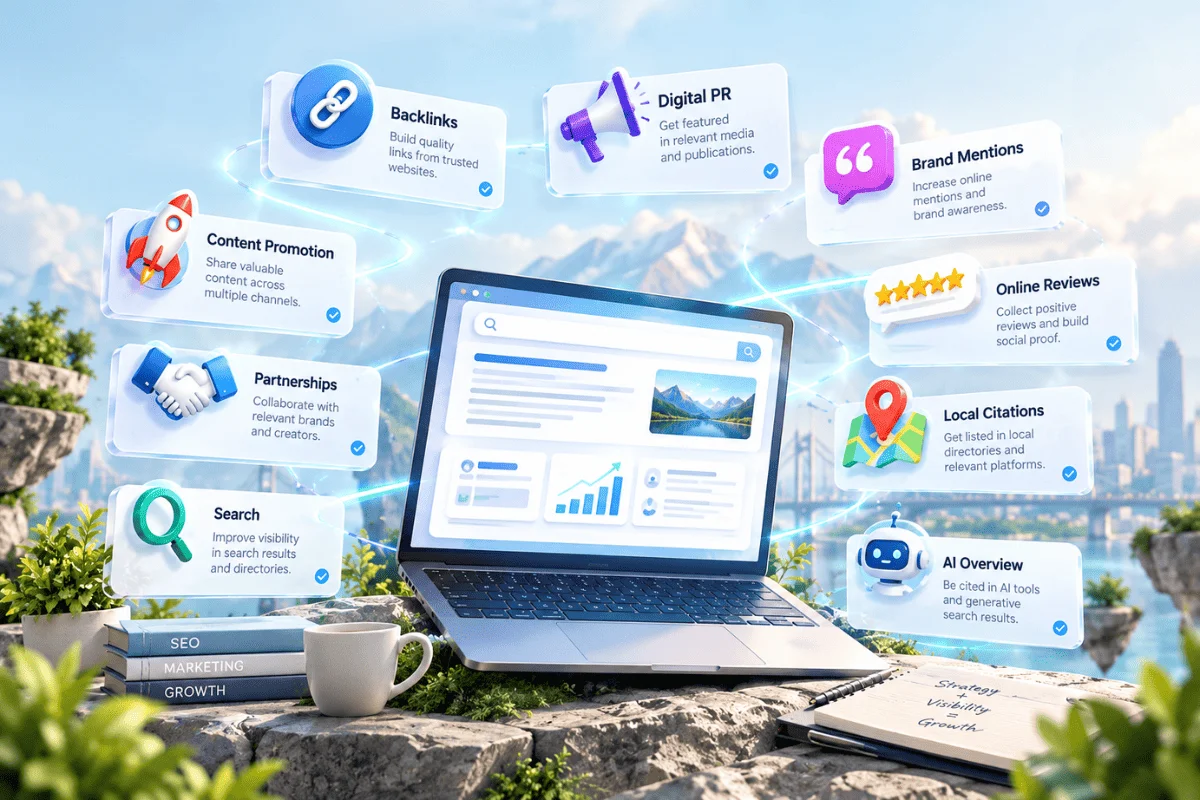
Off-page SEO is the work you do outside your website to build its authority, visibility, and reputation in search. It includes techniques such as link building, digital PR, brand mentions, reviews, local citations, and partnerships that show search engines and AI tools that other trusted sources recognize your site.
In 2026, these external signals matter even more as Google’s AI Overviews, ChatGPT Search, and Perplexity look for credible sources to reference in their answers. This guide explains which off-page SEO techniques to prioritize, how off-page SEO differs from on-page SEO, and how to build and measure a strategy that supports search visibility.
Key Takeaways
Off-page SEO builds authority through backlinks, brand mentions, digital PR, reviews, citations, and other signals outside your website.
Relevant, high-quality backlinks matter more than simply collecting a large number of links.
Digital PR, link-worthy content, guest posting, brand mention reclamation, and competitor research are some of the most useful off-page SEO techniques in 2026.
On-page SEO improves what happens on your website, while off-page SEO strengthens how your brand is referenced and recognized elsewhere.
New sites, established brands, and local businesses should prioritize different off-page SEO activities.
You can track results through referring domains, link quality, brand mentions, referral traffic, reviews, and search visibility.
Off-Page SEO in 2026: What It Means and Why It Matters
Here’s what Off-Page SEO means in 2026 and why it matters:
What Is Off-Page SEO?
Off-page SEO covers the ranking work that happens away from your own pages: link building, PR, mentions, reviews, and citations that vouch for your site elsewhere on the web. I think of it as your site's reputation, built by other people vouching for you instead of you talking about yourself.
Search engines read those outside votes as evidence that real publishers and readers trust your content enough to reference it. Off-page SEO and content marketing work best as a pair: content gives people something worth linking to, and off-page SEO turns those links into ranking power.
Why Off-Page SEO Still Matters in 2026
Off-page SEO isn't a leftover 2015 tactic. It still matters as search expands beyond traditional blue links into AI-generated answers, recommendations, and other discovery experiences.
Here's why it still holds a top spot on my priority list:
AI-driven search tools like Google's AI Overviews and ChatGPT search pull answers from sites with strong external credibility, not just clean code
E-E-A-T (Experience, Expertise, Authoritativeness, Trust) leans heavily on off-page signals like backlinks, reviews, and press mentions
Branded search volume, a known ranking factor, grows every time more people see your name on other sites
What Are The Best Techniques For Off-Page SEO in 2026
The best off-page SEO techniques in 2026 include the following:
Build High-Quality Backlinks
Backlinks remain the backbone of off-page SEO, and one link from a trusted, relevant site still beats fifty from low-quality directories. Before we chase any link, we check three things: relevance to our niche, the referring site's real authority, and whether a human editor placed it on purpose.
Prioritize relevance over raw domain authority
Diversify anchor text so the link profile looks natural
Avoid link farms and paid link networks that violate search engine guidelines
Use Digital PR to Earn Coverage and Links
Digital PR turns a newsworthy angle from your business into placements on journalists' and publishers' sites. This helps you earn links most people never think to request. I treat it like a scaled-down press campaign: find one genuinely interesting data point or expert opinion, then pitch it directly to relevant writers.
Pitch original data, surveys, or expert commentary
Build relationships with niche journalists before you actually need something
Track journalist request platforms for timely opportunities
Publish Guest Posts on Relevant Websites
Guest posting still works in 2026, but only on sites your actual audience reads, not random blogs collecting link exchanges. We choose target sites based on topical overlap first, then check their traffic and editorial standards before pitching a single idea.
Write for niche publications, not just any site with a 'write for us' page
Include one contextual link back to a genuinely useful page, not your homepage
Match each site's tone and length instead of reusing the same post everywhere
Reclaim Unlinked Brand Mentions
Plenty of sites mention your brand name without linking to you, and those unlinked mentions are some of the easiest wins in off-page SEO. We set up alerts and reach out politely, asking the site to add a link where it already makes sense.
Search your brand name plus common misspellings
Prioritize high-authority sites first
Keep outreach short, friendly, and specific about which page to link
Create Link-Worthy Content
Nobody links to content that doesn't give them a reason to. The team builds a handful of genuinely useful assets every year- original research, free tools, or in-depth guides- and lets outreach do the rest.
Original data and surveys attract press links naturally
Free tools and calculators earn long-term, evergreen backlinks
Visual assets like infographics and original graphics get shared and cited
Analyze Competitor Backlinks
I never build a link strategy blind. Seeing where competitors already earn links tells me which tactics and sites are working in my niche.
Pull competitor backlink profiles with a link-analysis tool
Look for patterns: guest posts, directories, PR mentions, resource pages
Target sites already linking to multiple competitors, not just one
Build Local Citations
For any business with a physical location or service area, local citations- your name, address, and phone number listed consistently across directories- directly influence local pack rankings.
List your business accurately on major directories and review platforms
Keep contact details identical everywhere to avoid confusing search engines
Prioritize industry-specific directories over generic ones
Off-Page SEO vs. On-Page SEO: What's the Difference?
Off-page and on-page SEO aren't competing strategies; they're two halves of the same ranking equation, and knowing the difference helps you budget your time correctly.
Factor | On-Page SEO | Off-Page SEO |
Where it happens | On your own website | Outside your website |
Main goal | Help search engines understand your content | Build trust and authority signals |
Examples | Title tags, headers, internal links, page speed | Backlinks, PR, guest posts, reviews |
Who controls it | You, directly | Other sites, indirectly through outreach |
Typical timeline | Faster to implement and see results | Slower, but compounds over months |
Neither replaces the other. On-page work makes a site rankable; off-page work makes it rank higher once it's already solid.
How to Build an Off-Page SEO Strategy and Measure Results
Here's the step-by-step, condensed:
Step | Key Actions |
Audit backlinks | • Pull your current backlink profile • Disavow only clearly manipulative links |
Analyze competitors | • See who links to them and why • Borrow tactics, not just targets |
Pick your techniques | • New sites: guest posts, citations • Established sites: digital PR, research • Local: citations, reviews, partnerships |
Build a prospect list | • Filter for relevance and real traffic • Keep it updated monthly |
Track results | • New/lost links, mentions, referral traffic • Ranking and visibility movement |
Timelines vary by site authority, competition, and consistency; there's no fixed number of weeks.
Off-Page SEO Checklist: What Should You Prioritize?
Site Type | Focus On |
New websites | • Local citations • A handful of guest posts • Reclaim mentions as they appear |
Established sites | • Digital PR campaigns • Original research and data content • Ongoing competitor monitoring |
Local businesses | • Consistent NAP citations • Google Business Profile and reviews • Local guest posts and partnerships |
Quick Off-Page SEO Checklist
☐ Audit current backlink profile
☐ Identify and pursue high-quality link targets
☐ Launch at least one digital PR pitch
☐ Reclaim unlinked brand mentions
☐ Keep local citations consistent
☐ Track rankings, referral traffic, and mentions monthly
FAQs
How long does off-page SEO take to show results?
Most sites see meaningful movement in three to six months, since backlinks and PR mentions need time to get indexed and trusted.
Do social media shares count as off-page SEO?
Not directly. Shares aren't a ranking signal on their own, but they raise visibility, which often leads to natural backlinks and mentions later.
Is off-page SEO more important than on-page SEO?
Neither wins alone. On-page SEO makes your site rankable; off-page SEO makes it rank higher once that foundation is already solid.
How many backlinks do I need per month?
There's no fixed number. Quality and relevance beat volume; a handful of strong links outperforms dozens of weak, irrelevant ones.
Conclusion
Off-page SEO isn't about chasing every tactic at once; it's about picking techniques that fit where your site actually stands right now. Start with a backlink audit, choose two or three techniques from this guide, and give them a full quarter before judging results. Off-page SEO compounds; the links and mentions you earn this year keep working long after you've moved on to the next project.