Beverage brands are built on repeat purchases, but most spend all their energy winning the first sale and none on keeping the customer around for the second.
They invest heavily in paid ads, creator partnerships, sampling campaigns, and introductory discounts to secure that first order. Then, once the package leaves the warehouse, communication drops off.
The customer enjoys the product, finishes it, forgets where they purchased it, and moves on.
That is an expensive leak.
Email marketing can generate an average return of $36 for every $1 spent, but that return does not come from sending more newsletters. They come from using automated, behavior-triggered messages that reach customers at the right point in their buying journey.
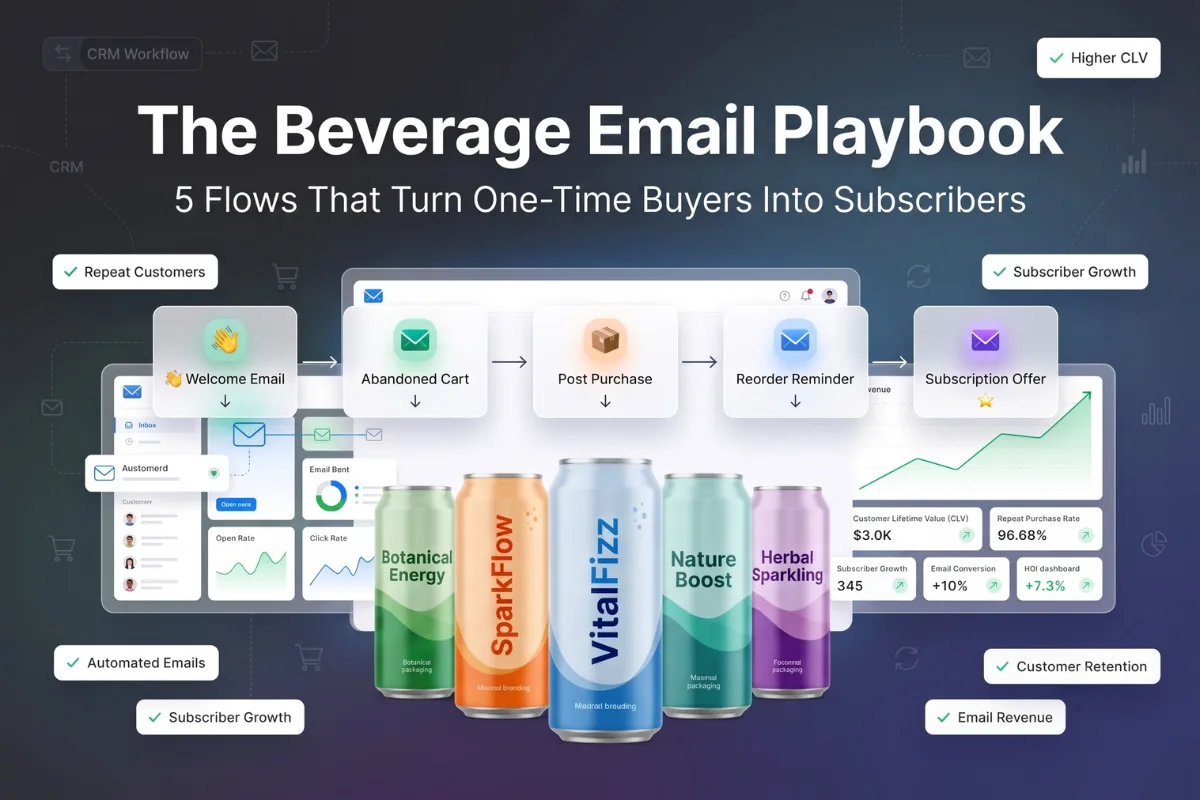
For beverage companies, the most valuable automations are not complicated. Five core beverage email marketing flows can help turn:
First-time visitors to buyers
Abandoned carts into completed orders
New customers into repeat customers
Repeat buyers into subscribers
Inactive customers into active customers
Here is how each flow works, what should trigger it, and what your brand should say.
Why Retention Beats Acquisition for Drink Brands
Acquisition gets the attention because it produces visible growth: more traffic, more first orders, and more customers entering the funnel.
Retention produces something more important: profitable growth.
According to Gartner, customer lifetime value is influenced by three primary factors:
Average order value
Purchase frequency
Customer lifespan
Improving any of these can increase the value generated from each customer.
This matters especially for beverage brands because the products are naturally replenishable. Customers do not purchase a drink mix, a case of cans, or a functional beverage to keep indefinitely. They consume it.
That creates a built-in opportunity for another order.
Consider two brands acquiring 1,000 new customers at the same cost.
Brand A | Brand B |
Most customers order once | Customers receive lifecycle emails |
Limited post-purchase contact | Reorders are encouraged automatically |
Few customers subscribe | Subscription is introduced at the right time |
Revenue depends on new traffic | Revenue compounds through repeat orders |
Brand A must keep paying to replace the customers who disappear
Brand B can generate additional revenue from people it has already paid to acquire.
The objective is not merely to “retain” every customer. It is to identify the customers most likely to buy again and make the next purchase easier, more relevant, and better timed.
That is exactly what lifecycle email automation does.
5 Flows That Will Win You Lifetime Subscribers
1. The Welcome Flow
A welcome flow begins when someone joins your email list, usually through a website form, quiz, giveaway, account registration, or first-order incentive.
Trigger
A visitor subscribes to your email list but has not yet purchased.
Goal
Turn initial curiosity into a first order while establishing what makes the beverage worth trying.
A welcome flow should not be one long company introduction. It should answer the questions standing between the visitor and checkout:
What is this product?
Why is it different?
Which option should I choose?
Can I trust this brand?
Is there a reason to order now?
Here’s a recommended email sequence that I believe will work for you
Email 1: Deliver the promise
Send the discount, guide, quiz result, or resource offered on the signup form.
Email 2: Explain the difference
Show the product’s most relevant differentiators without overwhelming the reader with every brand claim.
Email 3: Reduce uncertainty
Feature reviews, bestsellers, product comparisons, FAQs, quality standards, or preparation instructions.
Email 4: Create a buying path
Recommend a starter pack, variety pack, bestseller, or low-commitment first purchase.
Email 5: Close the loop
Remind the subscriber about the offer and provide a final reason to act.
Example Subject Line
Not sure which flavor to try first? Start here.
Subscription Opportunity
Do not push a subscription in the first welcome email. A visitor who has never tasted the product may not be ready to commit.
Instead, introduce the subscription after the customer has
Shown repeated product interest
Clicked through multiple emails
Purchased a trial or variety pack
Returned to the website several times
The welcome flow should earn the first order. Later flows can earn the recurring one.
2. The Abandoned Cart Flow
An abandoned cart flow begins when a shopper adds a product to their cart or starts checkout but leaves without completing the purchase.
Trigger
A known visitor adds an item to the cart or begins checkout without completing payment.
Goal
Remove the specific hesitation that is preventing the customer from completing the order.
Many beverage brands treat cart abandonment as a discount problem.
However, it is often a confidence problem.
The shopper may be wondering:
Will I like the flavor?
How many servings are included?
When will the order arrive?
Is the product worth the price?
Can I change or cancel a subscription?
What happens if I choose the wrong option?
Your cart flow should answer these questions before automatically applying the price cut.
Recommended Sequence
Email 1: Simple reminder
Show the exact products left in the cart and provide a direct return-to-checkout button.
Email 2: Handle objections
Highlight reviews, flavor descriptions, shipping information, guarantees, FAQs, or product comparisons.
Email 3: Reinforce value
Explain cost per serving, bundle savings, loyalty points, or subscription savings.
Email 4: Add urgency carefully
Use genuine inventory, shipping, or offer deadlines. Avoid fake countdowns that reset whenever the customer returns.
Example Subject Line
Your drinks are still waiting. Have questions before ordering
Cart abandonment is one of the strongest opportunities to coordinate email and SMS.
A practical sequence might look like this:
Email reminder after one hour
SMS reminder after four hours
Objection-handling email the following day
Final reminder two days later
Customers who have not opted in to SMS should remain on the email-only path.
3. The Post-Purchase Flow
The post-purchase flow starts immediately after someone places an order. This is not just a shipping notification sequence.
It is the bridge between the first and second transactions.
Trigger
A customer completes a purchase.
Goal
Confirm that the customer made a good decision, improve the product experience, and prepare the next logical purchase.
The first few days after checkout are high-attention moments. Customers are actively watching for order confirmations, shipping updates, preparation instructions, and delivery information.
That attention should be used to create confidence, not to bombard them with unrelated promotions.
Recommended Sequence
Email 1: Order reassurance
Confirm the purchase and explain what happens next.
Email 2: Product education
Show how to correctly prepare, store, chill, mix, or use the purchased beverage.
Email 3: Product discovery
Introduce complementary flavors, bundles, or formats based on the original order.
Email 4: Feedback request
Ask about the ordering experience or product once the customer has had enough time to try it.
Email 5: Introduce Subscribe & Save
Explain the practical benefit of receiving the product automatically.
Example Subject Line
Your order is on the way. Here's how to get the best experience.
Post-purchase messages should change depending on what the customer bought.
Someone who purchased a variety pack may need help selecting a favorite.
Someone who ordered 48 servings may not need a replenishment reminder for several weeks.
Someone who placed a second order may be ready for a subscription offer much sooner.
A single generic post-purchase sequence cannot capture all three journeys.
4. The Replenishment Flow
The replenishment flow is the most valuable email automation for consumable products.
It reaches the customer around the time their original supply is expected to run low.
Trigger
A calculated number of days has passed since the customer purchased a consumable product.
Goal
Generate the next order before the customer runs out—or make subscription the easier alternative.
However, don’t forget, timing is everything.
If you send the reminder too early, it feels irrelevant.
Send it too late, and the customer may already have purchased from another brand.
You should be able to estimate the Reorder Window
Start with:
Quantity purchased ÷ estimated daily consumption = approximate replenishment period
For example:
12 servings at one per day: approximately 12 days
24 servings at one per day: approximately 24 days
48 servings at one per day: approximately 48 days
These are starting assumptions, not permanent rules. Actual reorder data should eventually determine the timing.
Recommended E-mail Sequence
Email 1: Early reminder
Let the customer know they may be approaching the end of their supply.
Email 2: One-click reorder
Show the previously purchased product with a direct reorder button.
Email 3: Subscription alternative
Position recurring delivery as a way to avoid having to remember to reorder.
Email 4: Personalized recommendation
Suggest a larger-quantity, mixed-flavor bundle, or a delivery schedule based on previous behavior.
Example Subject Line
Running low? Restock before your last serving.
Subscription Opportunity
The replenishment flow is where subscription messaging often feels most natural.
The customer has already tried the beverage. The product has had time to become part of their routine. The inconvenience of running out is easier to understand now.
Do not sell subscriptions as a loyalty badge.
Sell it as a practical solution:
Never run out unexpectedly
Choose a suitable delivery schedule
Save on recurring orders
Reduce repeat checkout steps
Keep favorite products arriving automatically
5. The Winback Flow
A winback flow targets customers who previously purchased but have not returned within their expected reorder window.
Trigger
A customer has gone significantly longer than normal without placing another order.
Goal
Understand why the customer disappeared and give them a relevant reason to return.
Not every inactive customer should receive the same message.
A customer who ordered six months ago is different from a former subscriber who canceled last month.
Build segments such as the following:
One-time customers who never reordered
Former repeat customers whose activity stopped
Cancelled subscribers
High-value customers at risk of lapsing
Customers who only purchased during a discount
Recommended Sequence
Email 1: Reintroduce the brand
Remind them what they purchased and show what has changed since their last visit.
Email 2: Personalized recommendation
Feature products related to their previous order.
Email 3: Ask for feedback
Give customers an easy way to explain why they have not returned.
Email 4: Present an incentive
Use an offer only when appropriate and protect margins by excluding customers likely to reorder without one.
Email 5: Preference check
Allow the customer to reduce email frequency or choose the content they want, rather than immediately unsubscribing.
Example Subject Line
Still into [flavor], or has your taste changed?
A winback flow should not make the customer feel guilty for leaving.
It should make returning feel easy.
Email automation is only effective when connected to the right retention strategy.
See how brands combine SEO, influencer marketing, lifecycle email, and conversion optimization to scale.
Explore Our Case Studies
How KRATOMade Turns Buyers Into Subscribers
KRATOMade already has an offer that fits retention marketing: products customers consume, multiple flavors and formats, and a Subscribe & Save program.
Its subscription page allows customers to choose weekly or monthly deliveries while receiving automatic savings. The brand currently advertises 10% savings for weekly deliveries, while its loyalty program states that reward points may also be redeemed alongside eligible subscription savings.
Individual product pages also present subscription as one of several purchase options rather than the only way to buy.
The lifecycle opportunity is to introduce that offer according to customer readiness.
The Customer Journey
Step 1: First purchase
A new customer orders a single flavor, trial option, or mixed pack.
Step 2: Product education
Post-purchase emails explain how to prepare the drink, what to expect from the format, and how to explore other flavors.
Step 3: Preference discovery
Clicks and second-order behavior reveal which flavors and formats interest the customer most.
Step 4: Replenishment reminder
The customer receives a reminder based on the quantity purchased and expected reorder timing.
Step 5: Subscription invitation
Instead of presenting the subscription as a generic discount, the email recommends a suitable schedule based on the customer’s purchase history.
Example Message
Suppose a customer ordered Tropical Rush twice in the past 45 days. Instead of placing the same order manually, we would schedule a recurring delivery so your preferred flavor arrives automatically.
Repeat-purchase rate before flows: 16%
Repeat-purchase rate after flows: 25%
Subscription conversion rate: 8%
Email-attributed revenue increase: 45.2%
Average time between first purchase and subscription: 32.7 days
Even without aggressive discounting, this structure creates a clear progression from product discovery to repeat purchase and, eventually, recurring delivery.
The emails do not force the subscription.
They identify the moment when subscription becomes the most logical next step.
The 3 Email Mistakes Beverage Brands Make
1. Sending the Same Message to Everyone
A first-time visitor, recent buyer, repeat customer, and former subscriber should not receive identical promotions.
Segment by:
Purchase history
Product or flavor preference
Order value
Subscription status
Engagement
Expected replenishment date
Better segmentation makes email more useful and reduces unnecessary discounting.
2. Using Discounts as the Entire Strategy
Discounts can create urgency, but they cannot replace positioning, trust, or relevance.
Before offering 15% off, ask why the shopper has not made a purchase.
They may need:
A flavor comparison
Clearer subscription terms
Shipping information
Preparation instructions
Reviews
A smaller trial option
Solve the objection first. Discount only when the economics support it.
3. Measuring Opens Instead of Revenue
Open rates can help diagnose subject-line performance, but they should not be the primary measure of success.
Track:
Flow-generated revenue
Revenue per recipient
Click-to-conversion rate
Repeat-purchase rate
Time to second order
Subscription conversion rate
Subscriber retention
Unsubscribe and complaint rates
Modern privacy protections have also made open rates less dependable, increasing the importance of downstream metrics such as conversions and revenue per email.
Turn the First Order Into a Customer Relationship
The first sale proves that someone was willing to try your beverage.
It does not prove that they will remember to reorder.
That requires a connected lifecycle system:
The welcome flow earns the first purchase.
The abandoned cart flow removes hesitation.
The post-purchase flow improves the experience.
The replenishment flow captures the next order.
The winback flow recovers customers before they disappear permanently.
Add SMS at moments of urgency, and introduce a subscription when the customer has demonstrated sufficient interest in the product to understand its value.
You do not need dozens of automations to begin.
You need the five flows that cover the most important moments in the customer journey, along with a clear measurement plan to improve them.
Which flow is your beverage brand missing?
We build email and SMS lifecycle systems and subscription journeys specifically for beverage brands
Want to see where your current setup is leaking revenue? Get a free email scorecard when you reach out to Outreach Influencers.
Related Blogs :
The Beverage Founder's Guide to Paid Ads That Actually Convert
How Small Beverage Brands Go Viral on TikTok (No Budget Required)
SEO for Beverage Brands: How to Rank When You Can't Always Buy Attention