The cheapest customers you will ever get are often the ones already searching for what you sell.
They are typing questions like:
What is the best functional drink for ___?
Where can I buy ___ online?
Is ___ legal in my state?
___ vs. ___: What is the difference?
What ingredients should I look for in a ___ drink?
The demand already exists.
The question is whether your brand shows up when that demand becomes a search.
For beverage brands, that matters more than most founders realize. Paid media can generate visibility quickly, but every click has a price. Stop funding the campaign, and the traffic can stop with it.
SEO works differently.
Industry benchmarking consistently finds that organic acquisition tends to produce lower customer acquisition costs than paid channels over time because brands are not paying for every individual visit. Organic search also remains one of the largest sources of trackable website traffic.
That does not mean you should turn off your ads tomorrow.
It means you should stop building a growth strategy that collapses the moment your CPMs rise, an ad account gets restricted, or a platform decides your category suddenly needs another layer of approval.
This is especially important for beverage and botanical brands.
Some products are expensive to advertise.
Some sit in restricted or closely monitored categories.
Some need far more education than a 15-second ad can provide.
And some brands simply cannot afford to keep renting every customer they acquire.
That is where beverage SEO becomes a compounding growth channel.
The system is not complicated:
Understand what buyers search for.
Create the best page for that search.
Build enough trust for search engines to rank it.
Structure the information clearly enough for AI systems to understand and cite it.
Keep improving what already works.
Here is how to build that system.
Why SEO Is the Compounding Channel for Drink Brands
Most beverage companies think about growth in campaigns.
Launch the new flavor
Run the Meta campaign
Send the influencer boxes
Push the seasonal bundle
Increase the Amazon budget
Then the campaign ends, and the brand starts again.
SEO creates something different: an owned demand-capture system.
Imagine you publish a genuinely useful guide around a question your ideal customer searches every month.
At first, it might get 20 visits.
Then 100.
Then it starts ranking for related searches you did not originally target. Another website links to it. Google understands the topic more clearly. An AI search engine cites it.
A shopper discovers the guide, reads a comparison article, visits a product page, and buys.
The page you created six months ago is still working.
That is the compounding effect.
You are not simply creating “blog traffic.” You are building search assets across the entire buying journey.
A Beverage SEO Journey Can Look Like This
Search Stage | What the Buyer Might Search |
Discovering a category | What are functional beverages? |
Understanding an ingredient | What is kava? |
Comparing options | Kava drinks vs energy drinks |
Solving a specific use case | Best alcohol alternatives for social occasions |
Evaluating a brand | Brand A vs Brand B |
Looking for a product | Buy botanical drink mix online |
Checking restrictions or availability | Is Kratom legal in Florida? |
These searches do not all have the same commercial value.
But together, they create a pathway:
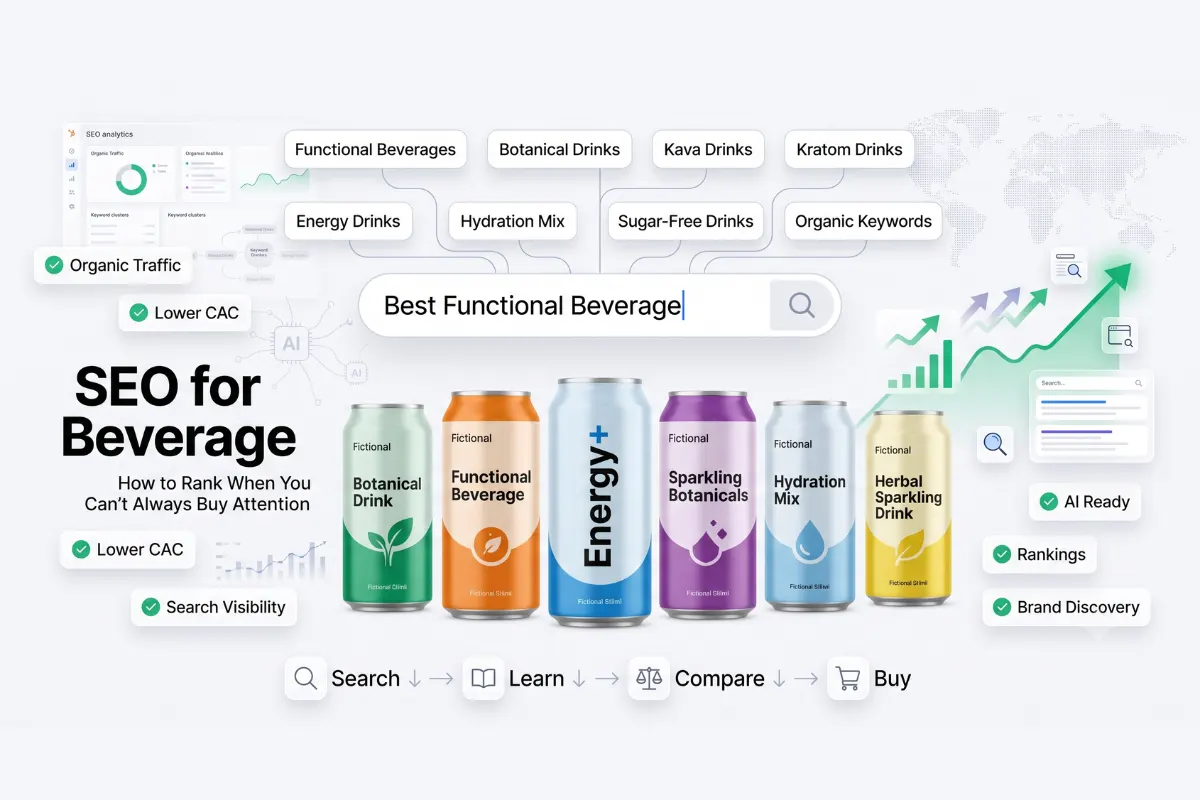
Curiosity → Education → Comparison → Evaluation → Purchase
That is the real role of SEO for a beverage brand.
It is not simply about getting more traffic.
It is about making sure your brand is present at the moments that influence a buying decision.
Keyword Mapping for Beverage SEO: Stop Treating Every Search the Same
One of the biggest SEO mistakes beverage companies make is creating a long spreadsheet of keywords and treating them as interchangeable.
They are not.
A person searching “what is kava?” is in a different stage of the journey from someone searching “buy kava drinks online.”
Your website architecture should reflect that.
For most beverage and botanical brands, I would map search demand into four primary buckets.
1. Category Keywords
These describe the broader product category.
Examples might include:
functional beverages
botanical drinks
Kratom drink mix
kava beverages
hydration powder
mushroom drinks
sugar-free lemonade mix
These are often competitive terms, but they help search engines understand what your company actually sells.
Your category pages should therefore do more than display a grid of products.
A strong category page can explain the following:
What is the category?
Who are the products designed for?
Available formats or flavors
Key differences between options
Common buying questions
Relevant product specifications
The goal is not to turn every collection page into a 3,000-word article.
The goal is to give both the buyer and the search engine enough context to understand the page.
2. Comparison Keywords
Comparison searches are some of the most commercially valuable opportunities in beverage SEO.
Examples:
Kava vs. Kratom
Powder vs ready-to-drink beverages
Brand A vs Brand B
Energy drinks vs functional beverages
Sugar-free vs regular drink mix
The buyer is no longer asking, “What is this?”
They are asking, “Which option is right for me?”
That is much closer to a purchasing decision.
Good comparison content should be useful even when your product is not automatically the winner in every category.
That sounds counterintuitive.
But trust converts.
A transparent comparison that explains differences in price, format, ingredients, convenience, flavor options, serving structure, and availability is more useful than a thin page designed only to say the following:
We are better. Buy now.
3. Use-Case Keywords
This is where many beverage brands leave significant search demand untouched.
Consumers do not always search for a product category.
They search for the situation they are trying to solve.
For example:
Drinks for a summer party
Alcohol-free drink ideas
Easy mocktail mixers
Drinks to keep in a gym bag
Single-serve drink mixes for travel
Low-sugar beverage alternatives
Use-case content helps your products enter conversations beyond the exact product name.
This is particularly useful for newer beverage categories where consumers may not yet know the terminology the industry uses.
Your customer does not care what you call your category internally.
They search using the language they already know.
Your keyword strategy needs to meet them there.
4. Legality and State-by-State Searches
For regulated or legally complex botanical categories, location-specific searches can become an important part of the SEO architecture.
Examples include:
Is Kratom legal in Texas?
Kava laws by state
Can you buy ___ in California?
Is ___ legal in my state?
These pages require much more care than a standard lifestyle blog.
Las change.
Local restrictions may differ from statewide rules.
Claims must be sourced.
Dates should be visible.
Updates should be tracked.
A page about product legality is not the place for recycled AI copy or a 50-state template that nobody fact-checked.
For brands operating in regulated categories, accuracy is part of SEO.
Because when trust fails, rankings are not the only thing at risk.
On-Page and Product-Page SEO: Your PDP Is a Search Landing Page
A lot of beverage websites have beautiful product pages and terrible SEO.
The page might have:
A large product image
A flavor name
A price
A subscription selector
Three generic benefit icons
An Add to Cart button
Visually, it looks good.
But search engines are being asked to understand an entire product from six lines of copy.
That is not enough.
Google describes SEO as helping search engines understand content while helping users decide whether they should visit a page.
Your product page should do both.
For beverage brands, a strong product page can naturally include:
1. A Clear Product Title
Not:
Tropical Rush
Better:
Tropical Rush Botanical Drink Mix
The exact structure will depend on your brand and category, but the page title should help a new visitor understand the product without already knowing your catalog.
2. A Useful Product Description
Your description should answer the questions a buyer would naturally have.
What is it?
What format does it come in?
What does it taste like?
How many servings or units are included?
What makes this version different from other products in the range?
3. Product Specifications
Make important information easy to scan.
Depending on the category, that might include the following:
Format
Flavor profile
Pack size
Serving information
Sweetener information
Storage requirements
Subscription availability
Shipping details
4. Unique Copy
Do not use the same paragraph across 40 flavor pages with only the flavor name changed. That creates dozens of pages with very little distinctive value.
Each page should contain information specific to that product.
What does raspberry taste like compared to Tropical Rush?
Which format is this?
What pack options are available?
How does the product fit within the larger range?
The more useful and product-specific the page becomes, the easier it is for both shoppers and search systems to distinguish it from the rest of the catalog.
5. Internal Links
Your product pages should not exist as isolated URLs.
Connect them naturally to:
Product categories
Flavor collections
Ingredient education
Comparison guides
Recipes
FAQs
Relevant buying guides
Think of your website as a network of meaning.
Internal links help people navigate that network.
They also help search engines understand how your pages relate to one another.
6. Product Structured Data
Where appropriate, structured data can help Google understand elements such as product information, pricing, availability, and other page details. Google explicitly supports product and merchant listing structured data, although implementing markup does not guarantee a rich result.
The principle is simple:
Do not make search engines guess what is already clearly known about your product.
E-E-A-T: Why Trust Matters More for Ingestible Brands
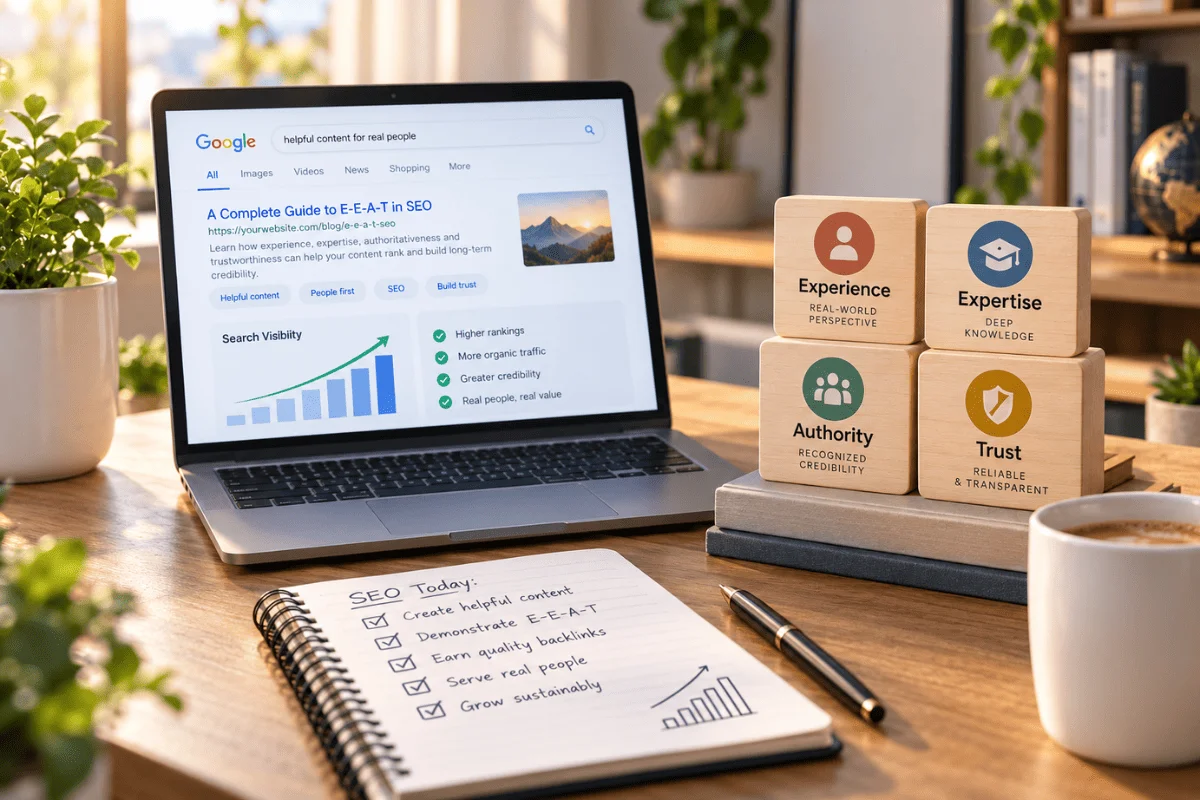
Google uses the concept of E-E-A-T: Experience, Expertise, Authoritativeness, and Trustworthiness when evaluating the qualities associated with helpful, reliable content.
And within that framework, trust matters most.
For beverage and botanical brands, that matters even more.
You are not selling phone cases.
You are selling something people put into their bodies.
That changes the trust equation.
1. The Trust Questions Every Beverage Website Should Answer
Trust Question | What Your Website Should Show |
Who is behind the company? | A clear About page, team information, and identifiable business details |
Who created or reviewed the content? | Author profiles, reviewer credentials, or editorial oversight |
Where do factual claims come from? | Scientific studies, official sources, and credible references |
Is the information current? | Visible publication and update dates |
Can customers verify the business? | Contact details, policies, company information, and customer support options |
Are product claims supportable? | Specific, accurate language backed by appropriate evidence |
Is marketing separated from factual information? | Clear distinctions between promotional messaging, education, and legal or scientific claims |
Google's people-first content guidance encourages website owners to demonstrate firsthand knowledge, clear sourcing, expertise, and an overall trustworthy experience.
2. What Beverage Brands Should Strengthen
In practice, that means improving signals such as the following:
About pages that clearly explain who the brand is
Author and expert profiles
Editorial or content review policies
Scientific references where relevant
Visible update dates
Detailed product information
Accessible contact information
Clear shipping and return policies
Testing or quality documentation, where appropriate
Accurate legal disclaimers
Original photography, testing, and product experience
3. More Content Does Not Automatically Mean More Authority
This is also why publishing 300 generic AI-written articles is not an SEO strategy.
Google allows generative AI to be used as a tool, but large-scale content production without meaningful added value can cross into scaled content abuse.
The competitive advantage is not producing more words.
It is producing information your competitors cannot easily replicate:
Your own data.
Your own product testing.
Your own expert input.
Your own customer questions.
Your own comparisons.
Your own research process.
Your own experience in the category.
That is where a real beverage brand can beat a content farm.
The E-E-A-T takeaway: Do not just tell Google that your brand is trustworthy. Build a website that gives both search engines and customers enough evidence to reach that conclusion themselves.
GEO and AEO: How Beverage Brands Get Cited by ChatGPT and Google AI
Search is no longer limited to traditional blue links.
A customer may now ask an AI system the following:
What are the best botanical drink formats for travel?
How do drink mixes compare with ready-to-drink beverages?
What should I check before buying a Kratom beverage online?
The answer may be generated before the customer ever visits a website.
That is where GEO (Generative Engine Optimization) and AEO (Answer Engine Optimization) become important.
1. ChatGPT: Optimizing for Generative Answers
For ChatGPT, GEO is about making your brand and content useful enough to be discovered, understood, referenced, and potentially cited when users ask relevant questions.
A beverage brand should focus on:
GEO Signal | What to Do |
Clear topical relevance | Build strong content around the products, ingredients, comparisons, and use cases your brand wants to be associated with |
Direct, extractable answers | Answer important questions clearly before expanding with supporting detail |
Structured information | Use tables, definitions, comparisons, FAQs, and descriptive headings |
Independent authority | Earn relevant backlinks, editorial mentions, reviews, and third-party references |
Technical accessibility | Make important content accessible to search and AI crawlers, including OAI-SearchBot, where appropriate |
The goal is not simply to mention your brand more often.
It is to build enough context and supporting evidence that an AI system can understand:
What your brand is.
What topics is it relevant to?
Why it may be worth referencing.
2. Google AI: Optimizing for AI Overviews and Answer-Led Search
For Google AI experiences, AEO focuses on making content easy to use as a clear answer to a specific query.
Strong SEO fundamentals still matter, but the presentation of information becomes especially important.
Beverage brands should focus on:
AEO Signal | What to Do |
Answer-first content | Give a concise response directly below the heading, then add an explanation. |
Specific headings | Use headings that clearly reflect the question or topic being answered |
Comparison-friendly formats | Use tables, bullets, definitions, and clear distinctions between options |
Reliable sourcing | Support factual, scientific, and regulatory claims with credible sources |
Strong page quality | Keep content accurate, useful, current, and closely aligned with search intent |
For example, instead of using a vague heading such as
Things to Know
Use:
What Should You Look for When Comparing Botanical Drinks?
The second version gives both the reader and the search system immediate context.
3. GEO and AEO Work Together
The distinction is useful, but beverage brands should not treat GEO and AEO as completely separate strategies.
AEO helps you answer the question clearly.
GEO helps your brand become a credible source within the wider answer ecosystem.
Together, they expand the goal of search visibility beyond:
Where do we rank?
to:
Are we being cited?
Are we being mentioned?
Which questions trigger our brand?
Which sources are being used instead of us?
This is not the death of SEO.
It is the expansion of SEO from ranking for searches to becoming part of the answer.
Case Study: How KRATOMade Turned Search Visibility Into Growth
KRATOMade shows what can happen when beverage SEO is built around the full customer journey rather than isolated keywords.
The strategy connected:
Educational content → comparison searches → category pages → product pages
Instead of relying only on branded searches, the site could capture demand across product formats, flavor-related searches, buying questions, and informational topics.
The Results
Metric | Result | Growth |
Gross Sales | $148K | +88% |
Orders | 815 | +98% |
Items Sold | 16,432 | +1,844% |
Total Users | 13,702 | +121% |
Transactions | 1,528 | +261% |
Items Purchased | 31,376 | +3,175% |
New Users | 6,789 | +29% |
Google Search Clicks | 1.95K | +885% |
Average Search Position | 17.2 | Improved from 39.7 |
What Drove the Opportunity
Rather than publishing random articles for search volume, the SEO structure could be built around three commercial content clusters:
Product & Format Searches: Kratom drink mixes, squeeze packs, gummies, flavor pages, and format comparisons.
Buying & Education Searches: Product comparisons, labeling information, pack sizes, and category education.
Legality & Access Searches: State-specific legality pages and regularly updated regulatory content.
The bigger lesson is simple:
SEO works best when content, category pages, and product pages support one another.
The informational content creates discovery.
The comparison content supports evaluation.
The product pages capture purchase intent.
That is how beverage SEO becomes a growth system, not just a traffic strategy.
You Cannot Always Buy Attention, but You Can Build Discoverability
Paid media, influencers, retail, Amazon, and social media all have a role in growth. But a beverage brand becomes vulnerable when every new customer depends on paying another platform for access.
SEO creates a different kind of asset.
A strong product page can keep ranking. A useful guide can keep attracting search demand. A comparison page can keep influencing buyers. And a trusted resource can become part of AI-generated answers.
That is why beverage SEO should not be treated as a monthly blog quota. It is a connected growth system built around:
Technical discovery and keyword strategy
Product-page and content optimization
Authority, trust, GEO, and AEO
Conversion across the full search journey
The brands that win will not necessarily publish the most content.
They will be the brands that make themselves easiest to find, understand, trust, compare, and recommend.
So start with one question:
What do your buyers Google before they buy?
Your answer is probably the beginning of your SEO strategy.
We run SEO, GEO, AEO, and content strategies for beverage and botanical brands that want to grow beyond rented attention.
Request a free SEO audit to see where your brand is currently being found, where competitors are taking the click, and where your next organic growth opportunities may be hiding.