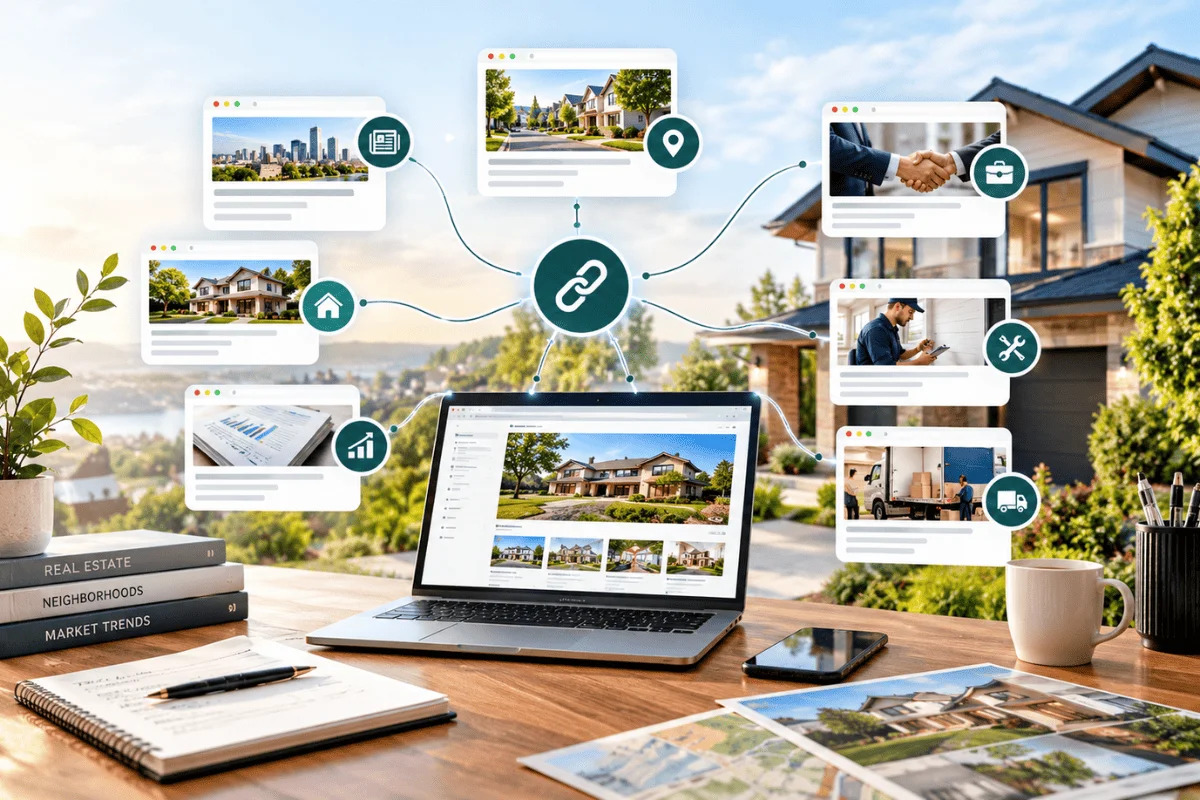
Link building for real estate is simply getting other websites to link back to your real estate site, agent profile, or property listings. Think of every backlink as a digital word-of-mouth recommendation. When local blogs, news sites, or community directories link to you, they tell search engines like Google that your site is trustworthy, has depth, and is relevant to your local market.
When our agency provides link building services for real estate and broker sites, the focus stays strictly on tactics that move the needle locally rather than generic SEO advice. This guide breaks down how specialized real estate link building works, sharing the exact strategies we deploy from local citations and neighborhood guides to strategic business partnerships to help property brands rank higher and attract steady buyer and seller traffic.
Key Takeaways
Quality real estate backlinks should come from relevant, credible, and locally connected websites.
Local citations, neighborhood resources, guest posts, partnerships, and digital PR can all support a real estate link-building strategy.
Brokers can build authority through market reports, local expertise, and partnerships with related businesses.
Link quality and relevance matter more than simply increasing backlink numbers.
Track referring domains, rankings, referral traffic, and organic visibility to measure link-building progress.
What Is Link Building for Real Estate?
Link building for real estate is the practice of getting other websites to link back to your property website or agent profile. I treat every backlink as digital word-of-mouth: it tells Google another site vouches for your content. Here's who those links typically come from:
Local publications covering housing, business, or community news
Industry blogs focused on real estate, mortgages, or home improvement
Business partners like lenders, inspectors, or moving companies
Local directories and citation sites tied to your service area
How Backlinks Help Real Estate SEO
Backlinks help real estate SEO by signaling to Google that your site is credible enough for other publishers to reference. Google's own guidance confirms that its ranking systems reward links earned through genuine editorial merit, not manipulation. Here's what a solid backlink profile does for your site:
Effect | What It Does |
Authority boost | Passes ranking value to your pages, helping them outrank thinner content |
Referral traffic | Sends visitors who click through from the linking site |
Faster indexing | Helps Google discover and crawl new listings or blog pages sooner |
Topical relevance | Strengthens your site's connection to real estate and local search |
What Makes a Good Real Estate Backlink?
A good real estate backlink is relevant, natural, and comes from a site with real traffic and authority. We run every opportunity through this checklist:
Factor | Why It Matters |
Relevance | Ties your brand to real estate or local audiences |
Authority | Higher-authority sites pass along more ranking value |
Traffic | A link only helps if the linking site actually gets visitors |
Placement | Editorial mentions in body content outrank sidebar or footer links |
Best Link Building Strategies for Real Estate
The best real estate link building strategies combine local relevance with content other sites genuinely want to reference. Here's a quick-scan overview before we break each one down:
Strategy | Best For | Effort Level |
Local citations | Fast, foundational link footprint | Low |
Local guides | Earning organic links from bloggers | Medium |
Local publications | Authority and brand credibility | Medium |
Guest posting | Targeted, relevant referral traffic | Medium |
Local business partnerships | Long-term, recurring links | Low |
Digital PR / original data | High-authority media coverage | High |
Competitor backlink analysis | Finding proven link targets | Medium |
Build Local Citations and Directory Links
Local citations are listings of your business name, address, and phone number across directories. I always start here since it's the fastest, lowest-effort way to build a link footprint.
Priority directories: Google Business Profile, Zillow, Realtor.com, Yelp, local chamber of commerce
Key rule: keep your NAP details identical everywhere to avoid confusing local search algorithms
Create Local Guides and Resources
Local guides earn links because other local sites and bloggers cite them as go-to resources. I've had the best luck pairing these with the local SEO guide on our site, since the two tactics reinforce each other. Hyper-specific angles beat broad city overviews:
Neighborhood breakdowns (best areas for families, first-time buyers, retirees)
School district comparisons
Local market trend reports updated quarterly
Earn Links From Local Publications
Local publications will link to you when you offer market commentary, housing data, or a quotable expert opinion. For sourcing credible figures, I often start with housing market data from the National Association of Realtors before layering in my own local numbers. My pitch checklist:
Lead with one fresh data point or local trend the outlet hasn't covered
Keep the pitch to three or four sentences — reporters skim
Offer to be a recurring source for future housing stories
Use Guest Posting
Guest posting is a way to curate an article for another site in exchange for a link back to yours, usually placed within the body or your author bio. A few ground rules:
Target real estate, home-improvement, and local business blogs
Match the topic to what that blog's readers already care about
Avoid sites that exist only to sell guest post placements
Partner With Local Businesses
Partnering with movers, home inspectors, designers, and mortgage brokers creates a natural reason for both sites to link to each other. The simplest structure:
Identify partners who serve the same buyers and sellers you do
Propose a resource-page swap: you link to their services, they link to yours
Add new partners quarterly to keep the link source list growing
Use Digital PR and Original Data
Digital PR means publishing original research like a report on local home price trends and pitching it for coverage. Reporters need fresh numbers, and a well-packaged local housing study gives them exactly that.
Pull data you already have: days-on-market, price-per-square-foot, inventory trends
Package it as a short report or one visual, not a dense spreadsheet
Pitch local journalists first, then trade or national outlets
Find Competitor Backlink Opportunities
Competitor backlink analysis means using a tool like Ahrefs, Semrush, and more to see which sites link to rival brokerages, then pitching those same sites.
Pull the backlink profile of two or three direct competitors
Filter out low-authority or irrelevant sites
Prioritize directories, roundups, and partnerships you can realistically replicate
Why Link Building Matters for Real Estate Websites
Link building matters because organic search, not paid ads, drives most long-term buyer and seller traffic. Here's what it does for your business:
Benefit | What It Means for You |
Improved search visibility | Helps pages rank for competitive, city-specific search terms |
Stronger local SEO | Reinforces your site's connection to a specific city or region |
Website authority | Builds trust signals that make it easier to rank new content over time |
Link Building for Real Estate Brokers
Link building for brokers looks different from agent-level SEO because brokers need authority across many agents, listings, and markets at once. I focus on two areas:
Build Links Around Local Expertise
Publish quarterly market reports that other sites end up citing
Create buyer and seller guides specific to your coverage area
Offer brokerage leadership as quoted sources for local housing stories
Connect with Related Local Businesses
Build formal partnerships with title companies, lenders, and home stagers
Create a shared resource page instead of relying on one-off mentions
Cross-promote content so both sites benefit from the relationship
Real Estate Link Building Mistakes to Avoid
The biggest mistakes come from chasing shortcuts instead of building genuine relevance and authority:
Mistake | Why It Hurts You |
Chasing low-quality links | Google discounts or penalizes unnatural link profiles |
Quantity over relevance | Dozens of unrelated links add little ranking value |
Exact-match anchor text overuse | Repetitive anchors look manipulative to Google |
How to Measure Your Link Building Results
You measure results by tracking growth over time, not just how many links you've earned. I check these monthly:
Metric | What to Watch |
Referring domains | Growth in unique sites linking to you |
Keyword rankings | Movement on target terms after each campaign |
Referral traffic | Visitors clicking through from linking sites |
Domain authority | Your site's overall authority score over time |
Free tool: Google Search Console for referring domains and clicks
Paid tools: Ahrefs or Semrush for authority scores and competitor comparisons
FAQs About Real Estate Link Building
Does Link Building Help With the Google Local Map Pack?
Yes, while map pack rankings weigh proximity and Google Business Profile signals heavily, a stronger backlink profile still supports the overall relevance and prominence score Google uses to rank map results.
Can Video Walkthroughs or Infographics Attract Backlinks?
Yes, visual assets like neighborhood infographics or video property tours often get shared and embedded by local blogs and news sites, which creates a link opportunity that text alone doesn't.
Is Link Building Different for Luxury Listings Than General Residential?
Luxury listings tend to earn links more easily from lifestyle, design, and travel publications, while general residential content earns more from local news and community resource sites.
Can a Brand-New Real Estate Website Compete for Backlinks?
Yes, a new site can still earn links through local citations and business partnerships early on, even before it has the content history needed for media or guest post opportunities.
Do Internal Links Affect Real Estate SEO the Same Way Backlinks Do?
Not the same way. Internal links drive Google's understanding of your site's structure and spread authority between your pages, while backlinks bring in outside authority your site doesn't otherwise have.
Final Thoughts
Real estate link building rewards patience and relevance over shortcuts and volume. Start with the tactics that fit your market and budget, track your referring domains and keyword positions monthly, and build from there.