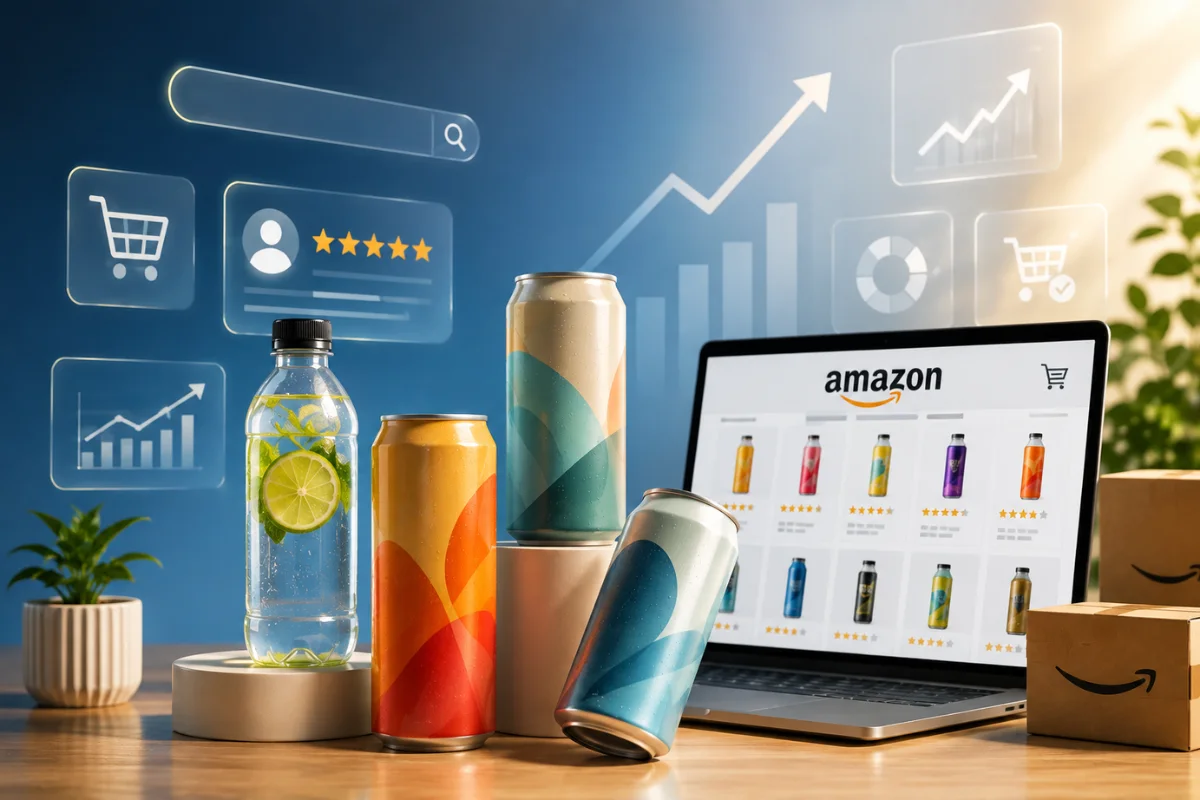
Amazon is one of the biggest product discovery engines in the world, and most beverage brands still treat their listing like an afterthought.
They upload a bottle image.
Write a title.
Add a few bullet points.
Run some ads.
Then wonder why a competitor with a weaker product keeps appearing above them.
The problem is that selling beverages on Amazon is not simply a matter of putting inventory on a marketplace. You are competing within a search, conversion, advertising, and repeat-purchase system simultaneously.
Your listing has to get discovered.
Your main image has to win the click.
Your product page has to convert that traffic.
Your reviews have to reduce uncertainty.
Your advertising has to create sales without becoming a permanent dependency.
And, for a repeatable product like a beverage, your first order should ideally become the beginning of a longer customer relationship.
That is the real answer to how to sell drinks on Amazon in 2026.
Amazon itself recommends that sellers use high-quality product information, images, advertising, and other selling tools to improve discoverability and sales. Food and beverage products must also meet Amazon's applicable condition, category, and product requirements before they can be sold.
In this guide, I will break down the system we use to evaluate a beverage brand's Amazon presence, from ranking and imagery to A+ content, reviews, Subscribe & Save, and the advertising metric that tells you whether paid growth is actually helping the business.
Amazon Is a Search Engine, Not Just a Store
The first mistake beverage brands make is thinking about Amazon like a digital supermarket shelf.
It is more useful to think about it as a search engine with a checkout button.
That shift has already changed how emerging food and beverage companies enter the market. Food Business News reported that digitally native brands have used Amazon to bypass several traditional retail barriers while gaining access to broader reach, customer feedback, and tools that help explain their products online.
In other words, Amazon is not simply another sales outlet. For the right beverage brand, it can become the place where demand is tested, customer language is discovered, and marketplace momentum begins.
You must have seen a shopper when they visit Amazon type something like:
energy drink powder
sugar-free hydration drink
sparkling functional beverage
relaxation drink
electrolyte drink mix
Amazon then has to decide which products deserve visibility.
That means your job is not simply to “have a listing.”
Your job is to build a listing that repeatedly gives Amazon stronger commercial signals.
The basic flywheel looks like this:
Visibility → Clicks → Conversion → Sales → Stronger Organic Position → More Visibility
Advertising can accelerate the process, but advertising alone cannot repair a listing that people do not want to click or buy.
Imagine two beverage products competing for the same search term.
Product A gets 10,000 impressions, but shoppers rarely click it.
Product B gets fewer impressions, but its packaging is immediately understandable, its image stands out cleanly, and shoppers click at a higher rate.
Now imagine Product B also converts more of those clicks into purchases.
Which product would you expect a marketplace to become increasingly confident showing?
That is why Amazon's growth is interconnected.
A better image can improve the click-through rate.
A clearer listing can improve conversion.
Better conversion can make advertising more productive.
More sales can contribute to stronger marketplace momentum.
And stronger organic visibility can reduce the percentage of each sale that must be purchased through advertising.
This is also why keyword research alone is not an Amazon strategy.
You need to understand:
What are shoppers searching for?
But you also need to answer the following:
Why would they click this product instead of the ten products around it?
And then:
Why would they buy after landing on the page?
For beverage brands, those three questions should guide almost every marketplace decision.
The 6-Element Main Image That Wins the Click
Your main image is not decoration. It is the first thing shoppers see before they read your title, bullets, or A+ Content.
In crowded Amazon search results, your image has to communicate three things almost instantly: what the product is, what the shopper is getting, and whether it looks trustworthy.
Amazon requires a main image for every product and applies specific image standards, including clear product presentation and category-specific requirements.
So, what makes a beverage's main image work? These six essential elements of a high-performing Amazon main image can determine whether a shopper scrolls past your product or clicks to learn more.
1. The Product Is Immediately Recognizable
Shoppers should not have to study the image to understand what you sell. The product format should be obvious even when the image is viewed quickly.
A can should clearly look like a can.
A bottle should be easy to identify.
Drink powders or sachets should show the actual pack format.
The product should dominate the image, not props or decorative elements.
2. The Packaging Is Legible
An image can look great at full size and still fail in search results. Since many shoppers browse on mobile, your packaging needs to remain clear at thumbnail size.
Test whether the brand name is still recognizable.
Make the flavor or variant easy to distinguish.
Ensure the basic product format is immediately clear.
Avoid packaging details that disappear when the image is reduced.
3. The Pack Count Is Obvious
Beverage listings can be confusing when customers cannot tell exactly how many units are included. Your image should visually match what the shopper will actually receive.
Make single bottles and cans clearly identifiable.
Show multipacks accurately.
Make variety packs easy to understand.
Avoid visuals that could make the quantity appear larger than it is.
4. The Product Fills the Available Space
A tiny product surrounded by excessive white space is easy to overlook. The product should have enough visual presence to compete in a crowded search results page.
Use the available image area effectively.
Keep the product large enough to notice quickly.
Maintain accurate proportions.
Stay within Amazon's image requirements.
5. The Image Reflects the Actual Variant
Flavor and variant recognition matter in beverage categories. Customers should be able to distinguish one SKU from another without having to read every detail.
Use clear visual differences between flavors.
Keep branding consistent across the product range.
Make the specific variant easy to identify.
Avoid nearly identical images for different products.
6. The Packaging Creates a Clear Point of Difference
You cannot overload an Amazon main image with promotional text, but the packaging itself can still communicate why the product stands out.
Highlight relevant information already printed on the packaging.
Make flavor, format, or pack size easy to notice.
Ensure the most important differentiator is visible.
Keep the image simple enough to earn the click.
The best Amazon main images do not try to explain everything. They create enough clarity and interest to make the shopper click, while the rest of the image stack and listing complete the sale.
A+ Content That Converts On Amazon
Search visibility got you the visit. Now you need to reduce doubt, answer objections, and make the buying decision easier.
That is where A+ Content can become especially valuable.
Amazon’s A+ Content tools allow eligible brand representatives and authorized sellers to enhance product detail pages with richer marketing content. But too many beverage brands use that space like a digital brochure:
Big lifestyle image
Brand slogan
Another lifestyle image
Generic paragraph about quality
Done.
That wastes the opportunity.
For beverages, A+ Content should answer the questions that stop shoppers from buying.
Module 1: Explain What the Product Is
Start with immediate clarity. Before telling the brand story, make sure the shopper understands exactly what they are looking at.
What kind of beverage is it?
What format does it come in?
What is the key differentiator?
What does the customer actually receive?
Do not open with a vague brand manifesto while the shopper is still trying to understand the product.
Module 2: Show Why It Is Different
Translate product features into clear reasons to choose the product. The goal is not to list every possible claim.
Focus on three or four meaningful differentiators, such as:
Format or convenience
Flavor range
Ingredient or formulation differences
Packaging or pack-size advantages
The goal is not to say more. It is to make the decision easier.
Module 3: Show How It Fits Into the Customer’s Routine
Help shoppers picture where the product fits into everyday life.
For example:
A drink mix may fit into a work bag, gym bag, or travel routine.
A multipack may make stocking up easier.
A ready-to-drink beverage may emphasize grab-and-go convenience.
A variety pack may appeal to shoppers who want multiple flavors.
The visual context should help customers imagine using the product without relying on unsupported claims.
Module 4: Compare the Product Range
Beverage brands often have a major advantage on Amazon: the ability to offer multiple flavors, formats, and pack sizes.
Use a comparison section to help shoppers quickly understand:
Flavors
Formats
Pack sizes
Product differences
Which option may best suit different preferences
A confused shopper leaves.
A shopper who understands the range is more likely to choose the right SKU—and potentially buy more than one.
Module 5: Answer the Objections
Think beyond features.
Ask what could make the shopper hesitate before clicking “Add to Cart.”
Common questions may include:
How many units are included?
What flavors are available?
How should the product be stored?
What ingredients does it contain?
Does it require preparation?
Is Subscribe & Save available?
How is one variant different from another?
A strong Amazon listing does not wait for customer service to answer these questions.
It answers them before they become reasons not to purchase.
This is one of the principles that matters when we look at marketplace positioning for beverage brands such as Mitra9: the listing needs to function as a complete decision environment.
The customer may know nothing about the brand before arriving. The page has to educate, differentiate, build confidence, and quickly move the shopper toward a purchase.
That is very different from a brand’s own website, where you control the navigation, landing pages, popups, email capture, and broader customer journey.
On Amazon, the competitor is often one click away.
Reviews Are Your Amazon Packaging
In a physical store, packaging helps create trust before purchase. On Amazon, reviews become part of that packaging.
Before a shopper even opens your listing, they may already see:
Product image
Title
Price
Star rating
Review volume
That makes reviews commercially important.
But there is a major difference between building review velocity and trying to manipulate reviews.
The goal is not to manufacture approval. It is to create a consistent, Amazon-compliant system in which genuine customers can leave genuine feedback.
1. Start With the Product Experience
No review tactic can permanently rescue a poor customer experience.
Common issues include:
Damaged shipments
Leaking bottles
Confusing pack counts
Poor flavor expectations
Incorrect listing information
Inconsistent inventory
Before trying to generate more reviews, study the reviews you already have.
Look for patterns.
If several customers misunderstand the size, the listing may have a communication problem.
If shoppers repeatedly praise a feature that appears only briefly on the page, you may have a positioning opportunity.
If the same complaint recurs, you may have an operational or product problem rather than a marketing problem.
Reviews do more than influence future buyers. They show you where the customer experience is working and where it is breaking.
The Federal Trade Commission prohibits several deceptive review practices, including purchasing fake reviews and conditioning incentives on customers expressing a particular sentiment.
2. Use Amazon’s Review Tools Correctly
Where available and appropriate, sellers can use Amazon’s own review-request mechanisms and other compliant programs.
The key is consistency.
Follow Amazon’s review policies.
Use approved review-request methods.
Avoid incentives or tactics that could influence review sentiment.
Make review generation part of ongoing marketplace operations.
Review velocity should not depend on a campaign you remember to run once every six months.
It should be built into the system.
3. Treat Review Analysis Like Customer Research
Do not only count stars.
Your reviews can reveal how customers actually think, compare, and talk about your product.
Look for:
Repeated purchase drivers
Common objections
Flavor language
Comparison points
Packaging issues
Customer vocabulary
Then feed those insights back into your
Listing copy
Images
A+ Content
Product positioning
FAQ content
Your best copywriting research may already be sitting underneath your Buy Box.
Subscribe & Save Is the Beverage Repeat-Revenue Engine
A beverage is rarely a one-time-use product.
That changes the economics of the category.
The first sale matters
But the second, third, fourth, and tenth orders may matter more.
Amazon's Subscribe & Save program supports recurring deliveries for eligible replenishable products, and products may be enrolled in the program in accordance with Amazon's program rules and seller settings.
For beverage brands, this creates an obvious opportunity.
A customer who has already:
discovered the product
evaluated the listing
taken the risk of ordering
received the product
decided they like it
is fundamentally different from a cold shopper.
The trust barrier has already been crossed.
Your marketplace strategy should reflect that.
But there is a catch.
You cannot build a subscription strategy around products that are constantly out of stock.
Repeat revenue depends on operational consistency.
That means marketplace management for beverages is not only
Can we rank this listing?
It is also:
Can we keep the product available when the customer comes back?
For eligible products, Subscribe & Save can help turn a transaction into a recurring purchasing relationship. The listing still needs to make the value of repeat purchasing clear, and inventory has to support the promise.
A brand obsessed only with acquiring the next customer may miss the bigger question:
How much revenue are we losing by making every customer rediscover and repurchase us manually?
Sponsored Products and TACoS: The Metric That Matters
Now we get to the part where many Amazon strategies go wrong.
Advertising.
Amazon Sponsored Products can help increase product visibility through paid placements, and Amazon Ads operates these campaigns on a cost-per-click basis.
The common mistake is treating ad efficiency as an isolated media-buying problem.
A brand sees a high ACOS and says:
“Reduce bids.”
Maybe.
But what if the real problem is the listing?
You can buy the right traffic and still lose money because
The main image does not earn the click
The offer is weak
The page does not answer objections
The reviews are uncompetitive
The wrong keywords are being targeted
The product converts poorly
This is why ACOS alone does not tell the full story.
Amazon defines ACOS as
Ad Spend ÷ Ad Revenue × 100
It measures the relationship between advertising spend and the sales directly attributable to those ads.
Useful?
Absolutely.
Complete?
No.
For a broader business view, look at TACoS: Total Advertising Cost of Sales
The basic formula is:
Ad Spend ÷ Total Sales × 100
Amazon Ads describes TACoS as advertising spend expressed as a percentage of total sales.
Why does that matter?
Because imagine this:
Your ad spend goes up.
Your advertising-attributed sales also go up.
Your ACOS looks acceptable.
But your organic sales never improve.
You may simply be paying for a larger percentage of the revenue you generate.
Now consider a different scenario.
You use advertising to build visibility for relevant terms.
The listing converts.
Sales increase.
Organic placement becomes stronger for commercially valuable searches.
Over time, total sales grow faster than advertising spend.
That is a healthier flywheel.
The point is not that TACoS should always fall every month. Launches, competitive pushes, seasonality, and expansion can temporarily change the number.
The point is that you need to know whether advertising is building the business or whether the business has become dependent on advertising.
A Better Sponsored Products Structure
For beverage brands, I would usually want visibility into at least three different jobs:
Discovery: Which searches are actually producing relevant traffic and sales?
Control: Which valuable search terms deserve dedicated campaigns and clearer budget decisions?
Defense and Expansion: Where should the brand protect its own demand, compete for category terms, or target relevant product opportunities?
Do not throw hundreds of keywords into campaigns and call it strategy.
Advertising data should teach you something.
Search terms that convert can inform:
listing copy
backend keyword decisions
future creative
product positioning
landing-page strategy
SKU expansion
Marketplace management should connect the advertising account to the listing.
Not treat them like two separate departments
The Real Amazon Beverage Ranking System
So, how do you sell drinks on Amazon successfully in 2026?
You stop looking for one trick.
There is no single title rewrite, keyword list, ad campaign, or A+ module that fixes everything. The brands that grow are the ones that connect the full system:
Get discovered through relevant search visibility.
Win the click with a clear, competitive main image.
Convert the visit with stronger listing content and customer proof.
Build genuine feedback and use reviews as customer research.
Create repeat revenue through replenishment and subscription opportunities.
Use advertising strategically while watching both campaign efficiency and total sales growth.
That is the difference between simply having products listed on Amazon and building a real marketplace sales channel.
At Outreach Influencers, we approach Amazon and marketplace management as a complete growth system. Our work with beverage brands such as Mitra9 and Kratomade has reinforced how important it is to understand the category, customer journey, product positioning, and marketplace environment, not just how to launch an ad campaign.
Because the real question is not
“Are we on Amazon?”
It is:
“Is our Amazon presence actually built to win?”
When did you last audit your listing from the perspective of a shopper seeing your brand for the first time?
We rebuild beverage Amazon listings and marketplace growth systems. Get a free Amazon listing score to see where your current page may be losing clicks, conversions, and revenue.