Eight out of ten beverage brands that come to us are convinced they have a traffic problem.
They don't.
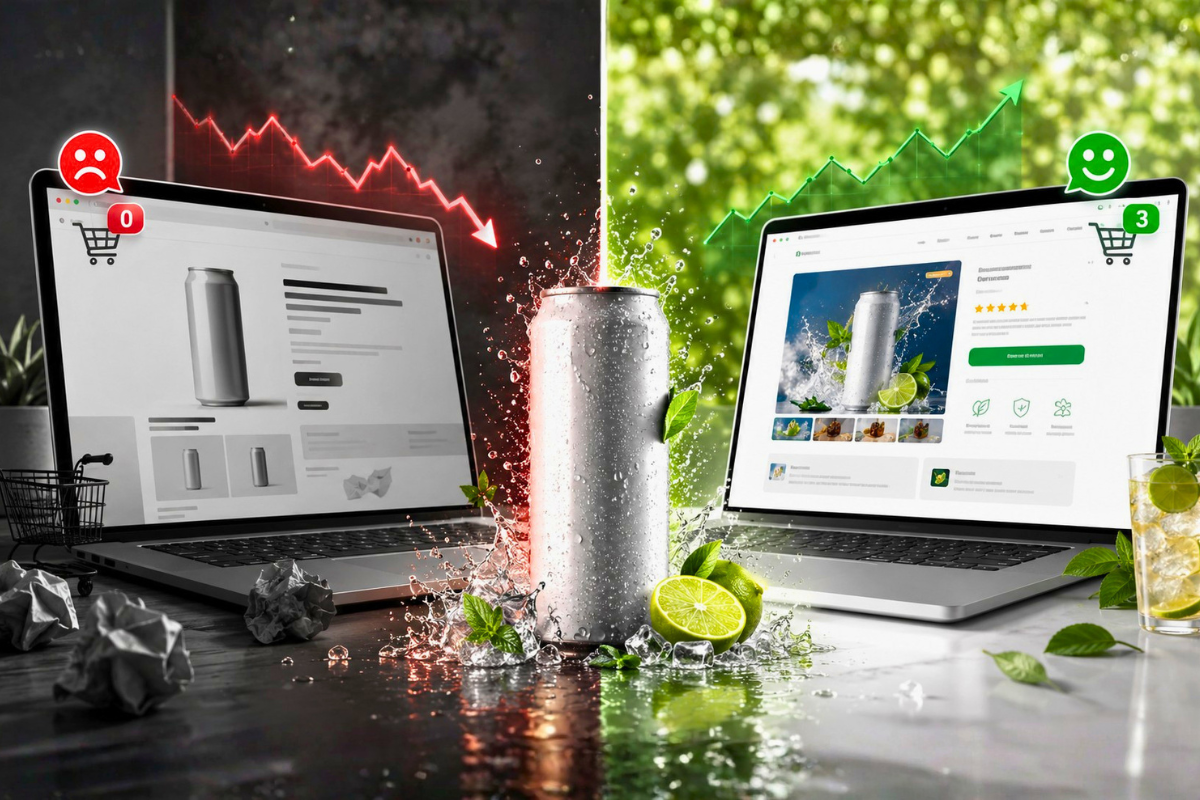
They have a leaky funnel, and they've been pouring ad spend into the top of it for a year, wondering why the bucket never fills up.
Here's the pattern we see over and over with kava, kratom, and functional beverage brands: traffic is up 40%, 60%, sometimes 100% year over year. Revenue? Barely moving. Because more visitors hitting a broken funnel just means more people watching your product page, adding to cart, and quietly leaving.
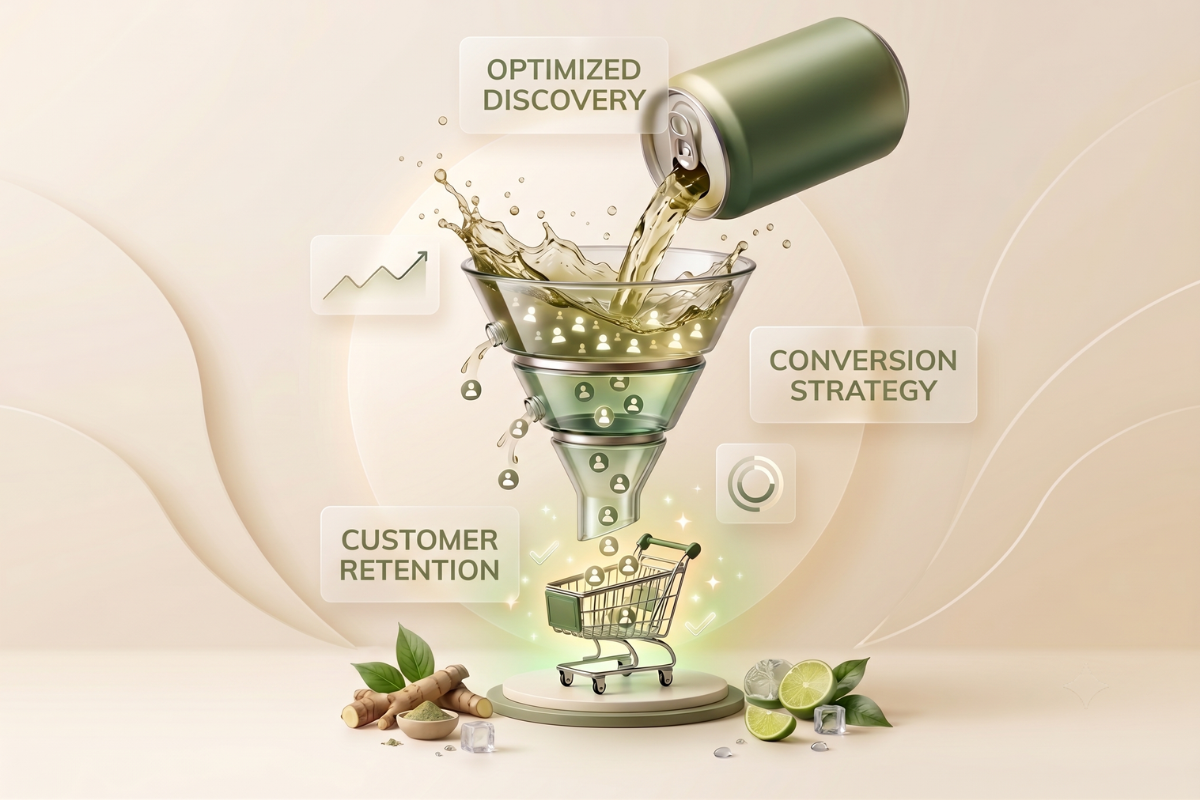
The fix isn't a bigger budget. It's a system. Three stages, in order:
Get found: the right people find you in the right places
Convert the click: your product page actually earns the sale
Keep them sipping: repeat customers do the heavy lifting on revenue
Here is the detailed system, along with a real funnel we rebuilt for a functional beverage brand, complete with screenshots, numbers, and more.
Why More Traffic Won't Fix Flat Sales
If your conversion rate is under 2%, adding traffic doesn't grow revenue; it grows your ad bill.
The food and beverage category actually converts well relative to the rest of e-commerce. Depending on the source, average conversion rates for food and beverage sit somewhere between 4.5% and 6.2%, well above the blended global average of 2.5–3%.
People buy drinks on impulse, they buy them again, and the decision is low-risk. That's your category's natural advantage.
So if your beverage brand is converting at 1.5–2%, you're not underperforming "average ecommerce", you're underperforming your own category, sometimes by 3x.
That gap is where the money is. And here's the part most brands miss: retention math beats acquisition math every time. Returning customers convert at 60–70%, versus just 5–20% for first-time visitors, and roughly 60% of total DTC revenue already comes from repeat buyers.
If your funnel isn't built to bring people back, you're leaving the cheapest, highest-converting segment of your audience on the table.
Stop asking "how do we get more eyeballs" and start asking "how much of the traffic we already have are we wasting?" That's Stage 1 through 3.
The Cheat Sheet To 10x Online Sales For Functional Beverage Brands
Stage 1: Get Found (The Channels That Actually Work for Drinks)
Not every discovery channel pulls its weight for a consumable product. Here's what actually moves the needle for beverage brands specifically:
SEO for high-intent, low-funnel keywords: "best kava seltzer for sleep," "kratom energy drink vs coffee," "functional beverage bundles." These aren't top-of-funnel awareness terms; they're people who are already shopping.
Supporting these pages with relevant authority link building can also strengthen their ability to compete in both traditional and AI-led search.
AI/GEO visibility: when someone asks ChatGPT or Gemini "what's the best kratom drink for focus," your brand needs to be the one that gets cited, not just ranked. This is quickly becoming a real discovery channel, not a nice-to-have.
Amazon and marketplace presence: a huge share of beverage discovery still happens where people already buy consumables on repeat.
Social as a discovery layer, not a closer: social converts at roughly 0.7–1.5% on its own. Its job is to build the audience that later converts through search, email, or retargeting — not to close the sale in one scroll.
The mistake brands make here is treating every channel as if it should convert on the first touch. SEO and GEO are built to find you. Stage 2 is what makes them worth it
Stage 2: Convert the Click (PDP + CRO Essentials)
Someone found you. Now what
If your product page reads like a spec sheet instead of a reason to buy, this is where the leak is happening, and for beverage brands, cart abandonment in the category runs as high as 72%, largely driven by delivery anxiety ("will it arrive fresh?") and checkout friction (surprise fees, minimum orders, slow load times).
The result: +120% order growth on just +60% traffic growth.
The essentials that move conversion for functional beverages:
| Element | Why it Matters | Quick Fix |
|---|---|---|
| Above-the-fold clarity | Visitors decide in seconds if this product is "for them." | Lead with the benefit, not the ingredient list. |
| Social proof near the buy box | Trust closes the sale, not features. | Place reviews and user-generated content directly beside the "Add to Cart" button. |
| Delivery/freshness reassurance | A leading cause of abandonment in food and beverage purchases. | Display shipping times and a freshness guarantee before checkout. |
| Mobile checkout speed | Desktop converts at ~3.9% versus mobile at ~1.8%. | Offer one-tap payment methods and minimize form fields. |
| YMYL-safe, clear copy | Regulated wellness categories require compliant yet trustworthy messaging. | Use precise, compliant language that communicates value without overclaiming. |
None of this requires a redesign. It requires fixing the two or three specific leaks that are actually costing you sales, which is exactly what a funnel audit is for (more on that below).
Stage 3: Keep Them Sipping (Email, SMS, and the LTV Math)
This is the stage almost every brand under-invests in, and it's the one with the best math.
Retention costs roughly 5x less than acquisition.
Beverage brands specifically have the lowest CAC of any DTC vertical (roughly $45–53), but also the thinnest single-purchase margin — meaning the first sale often barely breaks even. The second and third purchases are where the profit lives.
A simple post-purchase flow (replenishment reminder timed to your product's use-up cycle, subscribe-and-save offer, win-back sequence for lapsed buyers) is usually the single highest-ROI thing you can build this quarter.
If you're spending real money to acquire a customer and then never talking to them again after the box arrives, you're paying full price for a customer and only collecting half the value.
Case Study: How We Helped Mitra9 Grow Full-Funnel
We didn't just chase traffic for Mitra9's functional beverage line. We rebuilt the funnel — SEO and GEO content at the top, conversion-focused product and category pages in the middle, retention flows at the bottom and let the numbers do the talking.
The result: +120% order growth on just +60% traffic growth.
That gap — orders growing twice as fast as traffic — is the whole thesis of this article in one stat. It didn't come from spending more to get more visitors. It came from converting more of the visitors already showing up.
A few things worth pulling out:
Conversion rate hit 3.19%, above the general ecommerce benchmark and closing in on category-leading territory for functional beverages.
Returning customers grew 94%, almost matching order growth, which means retention, not just new-visitor acquisition, is doing real work here.
AOV climbed 18% on top of everything else, meaning every order is also worth more than it was a year ago
Stack conversion rate growth and AOV growth together, and you get compounding revenue growth, which is exactly why gross revenue nearly doubled (+99%) while traffic grew only 60%.
You can explore more ecommerce growth case studies to see how coordinated content, authority building and digital PR contribute to organic revenue—not just traffic.
The 5 Most Common Beverage Funnel Leaks
Vague product pages: "Premium kava blend" tells a visitor nothing. What does it do for them, in five seconds or less?
No freshness/delivery reassurance: In a category where 7 in 10 carts get abandoned, silence on shipping and freshness is a conversion killer.
Mobile checkout friction: If most of your traffic is mobile and most of your conversions are on desktop, that gap is pure lost revenue.
No post-purchase flow: Acquiring a customer and never emailing them again is the most expensive mistake in DTC beverage.
Content built for humans only, not AI search: If ChatGPT and AI Overviews can't cite your brand as an answer, you're invisible in a discovery channel that's only growing.
Your 20-Minute Funnel Self-Audit
Grab your analytics dashboard and check each item properly; do not guess.
Conversion Rate: Is your food or beverage conversion rate above or below 4.5%?
Mobile vs. Desktop: Is there more than a 1 percentage-point gap between your mobile and desktop conversion rates?
Returning Customer Revenue: Does approximately 60% of your revenue come from returning customers?
Second-Purchase Flow: Do you have an automated email or SMS flow encouraging customers to make a second purchase?
AI Search Visibility: Search “best [your category] for [use case]” in ChatGPT or Gemini. Does your brand appear?
Product Page Messaging: Do your top five product pages lead with a clear customer benefit rather than an ingredient list?
Your result:
If you checked “No” or “Not sure” on more than two items, you probably do not have a traffic problem. You have a specific, fixable leak in your funnel.
Recap: The 3-Stage System
Get found: combine high-intent SEO with AI search optimization and marketplace presence, rather than chasing vanity traffic.
Convert the click: a product page and checkout that removes the specific friction points killing beverage conversion.
Keep them sipping: retention flows that turn a break-even first order into a profitable relationship.
Mitra9 didn't grow orders by 120% by getting more traffic. They grew orders by 120% by fixing what happened after the traffic arrived.
So which stage is your brand leaking at?
If you're not sure, that's exactly what a funnel teardown is for.
This is the exact system we build for beverage and functional drink brands: full-funnel SEO, CRO, email, and paid working against one roadmap instead of five disconnected vendors. Want a free teardown of your funnel? [Book a free beverage funnel teardown]