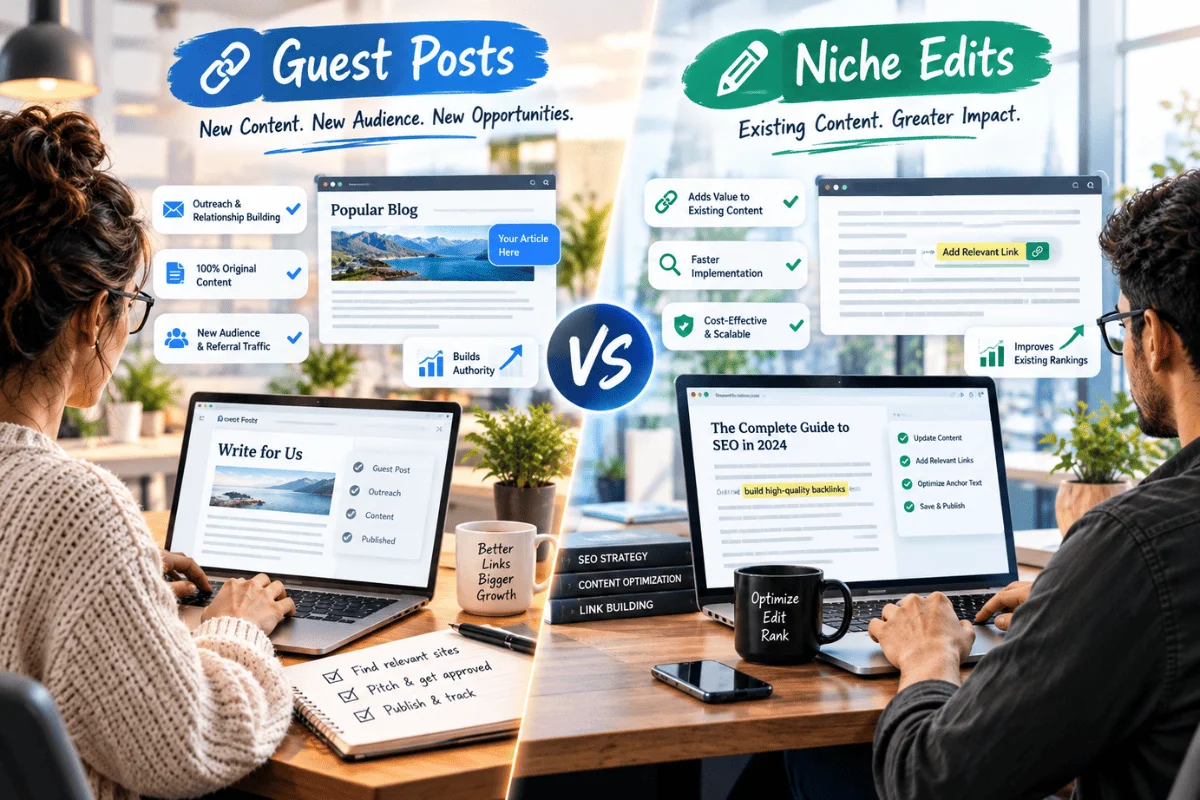
Guest posting means writing an original article for another site in exchange for a link, while a niche edit adds a link into content that's already published and already indexed. That single difference explains almost everything else: niche edits usually go live within days because the host page is already crawled and trusted, while a guest post can take two to six weeks once outreach, editorial review, and the publisher's schedule are factored in.
Our team at Outreach Influencers has run both tactics across dozens of client campaigns, and the pattern holds up consistently: niche edits tend to move rankings faster on one specific page, while guest posting builds the kind of brand authority that keeps compounding months after the link goes live. Below is a full breakdown of how each strategy works, what they cost, where each one earns its keep, and how to combine them without wasting budget.
Key Takeaways
Guest posts create new content assets with backlinks, while niche edits add links to existing indexed pages.
Niche edits usually provide faster placements, while guest posts offer stronger brand visibility through bylines and original content.
Guest posting gives more control over content, link context, and brand messaging.
Niche edits can be useful for campaigns focused on improving specific pages without creating new articles.
Link quality, relevance, traffic, and website authority matter more than the link-building method itself.
The best SEO strategies often combine guest posts and niche edits based on campaign goals, budget, and timeline.
Avoid low-quality placements, irrelevant websites, and unnatural anchor text patterns to protect backlink value.
Guest Posting vs Niche Edits: Quick Comparison
Six factors separate these two tactics in practice. Our team leans on this table whenever a client is trying to decide where to put next month's link-building budget.
Factor | Guest Posting | Niche Edits |
Content created | A full, original article gets written and published on the host site, shaped around your topic, brand voice, and target keyword. | No new content is created. The link is added into a paragraph on a page that's already live and already indexed. |
Turnaround time | Typically two to six weeks once outreach, editorial review, revisions, and the publisher's schedule are all factored in. | Often live within a few days to about a week, since there's no writing or editorial approval process involved. |
Cost per link | Usually $500 to $1,000 or more once writer fees, outreach hours, and the placement fee are all added together. | Generally runs 20 to 30% cheaper than a comparable guest post, since no content production cost is involved. |
Brand visibility | High. Most placements include a byline, an author bio, and sometimes a linked headshot on the host site. | Minimal to none. Readers rarely notice who's behind a link inserted into someone else's existing article. |
Control over context | Full control over the topic, tone, supporting arguments, and exactly where the link sits inside the piece. | Limited. The anchor and surrounding sentence have to fit into a paragraph someone else already wrote. |
Best for | Building topical authority, brand recognition, and a naturally diverse backlink profile that compounds over time. | Getting quick ranking movement on a specific page without a large content production budget. |
What Is Guest Posting?
Guest posting is the practice of writing and publishing an article on someone else's website in exchange for a byline, an author bio, and one or more contextual links back to your site. The host site gets free, relevant content for its audience; your brand gets exposure to readers who already trust that publication.
It remains one of the most widely used link-building tactics, and also one of the most heavily scrutinized: Google's spam policies specifically call out large-scale guest posting networks and thin, AI-generated content built mainly to carry backlinks.
How Guest Posting Works
The process usually follows the same sequence, whether the target is a niche blog or a mid-size industry publication:
• Research sites that already rank for topics close to your target keywords and check for real organic traffic
• Pitch a specific, well-researched topic idea rather than a generic 'can I write for you' email
• Write a full, original article that matches the host site's tone, style, and editorial standards
• Include one or two contextual links using natural, varied anchor text
• The site publishes the piece, often with a byline, an author bio, and sometimes a linked headshot
Pros and Cons of Guest Posting
Pros | Cons |
Builds real brand visibility through a byline, author bio, and sometimes a linked headshot on a reputable site. | It takes real time. Most placements need two to six weeks between outreach, writing, and publication. |
Gives full control over the article's tone, structure, and exactly how the link fits into the narrative. | No guarantee of acceptance. Well-known publications reject the majority of pitches they receive. |
Passes stronger authority signals in competitive or YMYL niches, since a named author and editorial review both count. | Requires a steady supply of writing resources, whether that's an in-house writer or a hired freelancer. |
Opens the door to an ongoing relationship with the site's editor, which often leads to more placements later. | Harder to scale quickly across many sites at once compared with a simple link insertion. |
What Are Niche Edits?
Niche edits, also called curated links or link insertions, add a backlink into an already-published, already-indexed article on a relevant site instead of creating new content. Because the host page has been live for a while and may already rank or carry inbound links of its own, an inserted link can start passing value almost as soon as the page is next crawled. The tradeoff is control: the article, tone, and surrounding context were all decided by someone else long before your link showed up.
How Niche Edit Links Work
• Find an aged, relevant article that already ranks for a topic close to your target page
• Check the page's real organic traffic, current rankings, and how many outbound links it already carries
• Reach out to the site owner directly, or work through a vetted link-building partner
• Negotiate a placement fee for inserting a link into a relevant paragraph of the existing text
• The page goes live with the update, often within days of the request being approved
Pros and Cons of Niche Edits
Pros | Cons |
Can go live within days, since the host page is already published, indexed, and sometimes already ranking. | The link can be edited out or removed later if the site owner updates or refreshes the article. |
Usually runs 20 to 30% cheaper than a guest post, since no new content has to be written. | Offers little to no brand exposure, since there's no byline or author bio attached to the placement. |
Benefits from whatever authority, traffic, and internal links the host page has already built up over time. | Harder to verify how much real organic traffic the host page still gets before paying for a spot. |
Easy to scale across a batch of pages when a campaign needs several links placed quickly. | Carries more risk if the page already has too many inserted links or the vendor cuts corners on quality. |
Niche Edits vs Guest Post: Key Differences
Both tactics build backlinks, but they pull on different levers entirely. Here's how they compare on the factors that actually affect a campaign's results.
Content Creation and Control
Guest posting hands over full control of the article: the topic, the supporting arguments, the terminology, and exactly where the link sits inside the piece. Niche edits offer none of that. The link gets dropped into a paragraph someone else already wrote, on a page whose structure and quality were decided long before you got involved.
If the surrounding article is outdated, thin, or already overloaded with other links, your placement inherits every one of those weaknesses.
Link Placement and Context
It helps to think of this as two separate clocks. Placement speed is how quickly a link goes live; discovery speed is how quickly search engines actually process it. Niche edits tend to win on both counts, since the host page is often already indexed, internally linked, and receiving its own organic traffic before your link is even added.
A brand-new guest post doesn't start from zero, but it needs the publisher's internal links, sitemap inclusion, and its own crawl history to build up before the link inside it carries much weight.
Speed and Scalability
Niche edits win clearly on speed. There's no writing, no editorial review, and no publishing calendar to wait on, which makes it far easier to scale across many sites in a short window.
Guest posts move slower because every placement needs a pitch, a full article, and often a revision cycle before it ever goes live, and popular publications can take weeks just to respond to an initial outreach email.
Cost and Resource Requirements
Guest posts carry two cost layers: content production, which typically runs $200 to $500 per article depending on length and niche, and the placement itself, which for a mid-authority site often adds another $300 to $600. Combined, a single guest post link frequently lands between $500 and $1,000. Niche edits skip the content layer entirely, which is why comparable placements on similar sites usually cost 20 to 30% less. The catch is that ongoing spend can still add up fast once a campaign scales across dozens of pages.
Brand Visibility and Authority Building
Guest posts carry an author bio, a byline, and sometimes a linked headshot, all of which build recognizable brand presence over time. They also tend to carry more weight for E-E-A-T, since a named author being reviewed and accepted by an independent editorial team signals real expertise, not just a paid placement. Niche edits are built for rankings, not recognition. There's no byline attached, and most readers never notice who's behind the inserted link.
Guest Posting vs Niche Edits: Which Builds Authority Faster?
'Faster' depends entirely on what kind of authority is the goal. For topical, ranking-focused authority on one specific page, niche edits tend to move the needle sooner simply because the host page skips the indexing and trust-building steps a brand-new article has to go through. For brand authority that compounds over months, the kind that gets a company recognized as a real voice in its space, guest posting wins because of the editorial vetting and named-author signal that a link insertion can never fully replicate.
When Guest Posting Is the Better Choice
• Building a name in a competitive or YMYL niche, where E-E-A-T signals carry extra weight with Google's quality raters
• Establishing thought leadership through bylines, author bios, and a consistent publishing history
• Driving referral traffic from an audience that already trusts the host site's editorial standards
• Diversifying a link profile with content-rich, editorially reviewed placements rather than inserted links
When Niche Edits Are the Better Choice
Niche edits make more sense when the priority is ranking movement on a specific page, the content budget is tight, or the goal is simply diversifying anchor text without the overhead of commissioning new articles every time. The chart below shows the typical gap in turnaround time and per-link cost between the two approaches, based on the ranges our team sees most often across client campaigns.
How to Choose Between Niche Edits and Guest Posts
Match the tactic to the situation rather than picking one to use everywhere:
Your Situation | Best Choice | Why |
You want long-term brand authority and topical trust | Guest Posting | Bylines and editorial review compound over time and carry stronger E-E-A-T signals. |
You need a fast ranking boost on a specific page | Niche Edits | The host page is already indexed and trusted, so the link can pass value within days. |
Your budget can't support content production | Niche Edits | No article has to be written, so cost runs 20 to 30% lower per link. |
You're in a competitive or YMYL niche | Guest Posting | Named-author, editorially reviewed content matters more where Google applies extra scrutiny. |
You want to diversify anchor text quickly | Niche Edits | Links slot into varied existing content without writing a new piece each time. |
You want a durable, natural-looking link profile | Both | Guest posts add authority and depth; niche edits add speed and scale. |
Common Mistakes to Avoid With Guest Posts and Niche Edits
Prioritizing Quantity Over Link Quality
• Chasing a high link count on cheap, low-authority sites does more harm than good
• Many sites on open guest-post marketplaces carry weak domain metrics and only a trickle of real traffic
• A handful of links from relevant, well-trafficked pages outperforms dozens from thin or spammy sites
Choosing Irrelevant Websites
• A link from an unrelated niche sends a weak relevance signal, no matter how strong the site's metrics look
• Topical relevance matters more than a raw authority score for both guest posts and niche edits
• A highly relevant placement on a modest site often outperforms a generic one on a bigger domain
Ignoring Anchor Text Diversity
• Repeating the same exact-match anchor text across placements looks unnatural and can trigger algorithmic flags
• Mix branded, naked-URL, partial-match, and generic anchors instead of relying on one pattern
• Cap exact-match keyword anchors at roughly 20 to 30% of the total link profile
Buying Low-Quality Link Placements
• Bulk packages promising dozens of placements for a flat low fee almost always come from link farms or private blog networks
• Google's link spam policies treat these as manipulative regardless of how the content is framed
• Its SpamBrain system can quietly neutralize a link's value without ever issuing a manual penalty
• Cleaning up the aftermath costs far more time and money than sourcing quality placements the first time around.
Guest Posting vs Niche Edits: Final Thoughts
Neither guest posting nor niche edits is the single right answer for every campaign. Guest posting builds the kind of brand authority that compounds over time, while niche edits deliver the fast, scalable link acquisition that keeps rankings moving in the meantime.
Data from Ahrefs' backlink growth research shows that top-ranking pages keep accumulating new referring domains month over month, which is a reminder that link building isn't a one-time task for either tactic. Most SEO strategies that hold up long-term use both, matched to the right page and the right goal at the right time.
FAQs About Guest Posting vs Niche Edits
How do I know if a website accepts quality guest posts?
Look for websites with relevant topics, consistent publishing standards, real organic traffic, engaged audiences, and editorial guidelines instead of sites that only exist for publishing guest articles.
Can guest posts generate traffic or only backlinks?
Guest posts can generate referral traffic when published on websites with an active audience and when the content provides genuine value to readers.
What makes a niche edit different from buying a backlink?
A quality niche edit involves placing a relevant link inside existing content where it naturally supports the topic. Buying low-quality links solely for manipulation can violate search engine guidelines.
How long do guest post and niche edit backlinks last?
The lifespan of a backlink depends on the publishing website, content updates, editorial decisions, and whether the link continues to remain relevant to the page.
Do guest posts help with brand authority beyond SEO?
Yes. Guest posts can support brand recognition by putting your expertise in front of new audiences and creating publicly available content associated with your brand.